


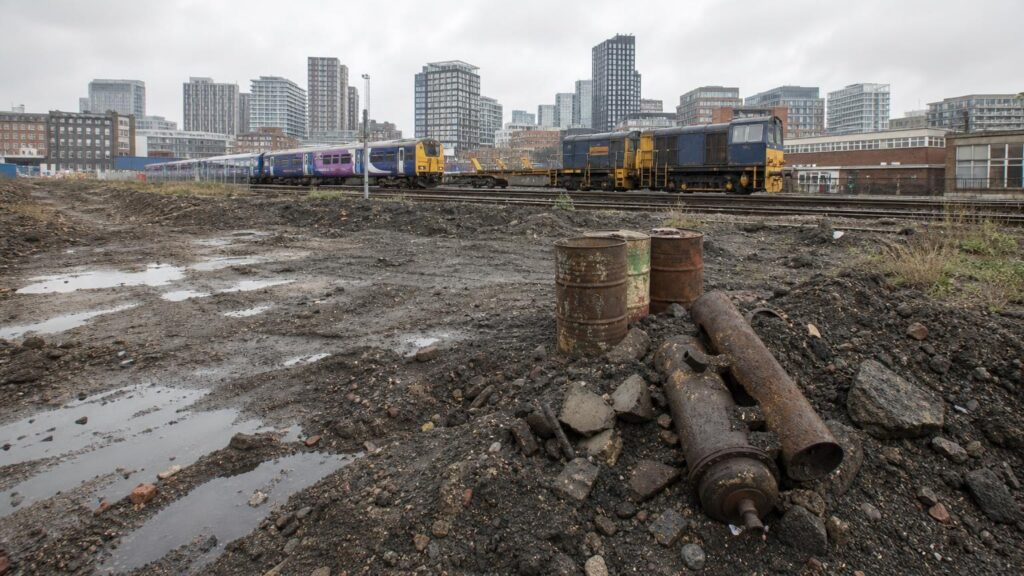
UK infrastructure investment—rail upgrades, road schemes, and wider regeneration corridors—often brings development opportunities around stations, junctions, and transport nodes. These sites can be commercially attractive, but they also commonly carry a legacy of contamination due to historic rail, fuel, industrial, and maintenance activities.
Before you commit to a scheme, a Phase 1 Desktop Study provides essential early-stage risk clarity. A Phase 1 Desktop Study reviews the site’s historic land use, nearby industrial sources, and environmental setting to identify potential pollutant linkages. In transport-adjacent locations, this can be the difference between a smooth planning pathway and a costly surprise.
Why transport corridors can be higher risk
Historically, rail and transport land can include workshops, sidings, fuel storage, ash and clinker deposits, chemical stores, and imported fill. Even where the development plot itself seems clean, adjacent land use can introduce pathways such as migrating vapours, shallow groundwater movement, or windblown dust. A Phase 1 Desktop Study draws that wider context into your planning submission so decision-makers can see that risks have been assessed appropriately.
Typical UK development types near infrastructure
- Residential-led regeneration around stations and town centres
- Commercial or logistics development near road and rail junctions
- Mixed-use redevelopment of former depots and yards
- Infill schemes on historic sidings or backland plots
What your Phase 1 should cover for these sites
A transport-adjacent Phase 1 Desktop Study should be thorough on historical mapping and local context. It should identify potential contaminants associated with rail and industrial operations (for example hydrocarbons, PAHs, metals, asbestos, and potential ground gas), assess plausible pathways to receptors, and discuss controlled waters sensitivity where relevant.
Crucially, the Phase 1 Desktop Study should provide a defensible conclusion: whether the preliminary risk is low, or whether intrusive investigation is warranted. That helps you plan your programme and budgeting with confidence.
Planning and stakeholder confidence
Transport-driven regeneration often involves multiple stakeholders: planners, consultants, funders, and sometimes landowners with complex histories. A clear Phase 1 Desktop Study demonstrates competent due diligence and supports faster consensus. It also helps reduce the risk of over-scoping further work simply because risk has not been explained properly at the desktop stage.
If your scheme is near rail or major transport infrastructure, start with a planning-ready Phase 1 Desktop Study. EnviroSolution provides UK-wide desktop studies that are practical, clear, and aligned with planning expectations.
Get your Phase 1 Desktop Study here: Phase 1 Desktop Study.
Don’t underestimate adjacent land
Infrastructure-led regeneration often involves fragmented land ownership and overlapping historic uses. A strong Phase 1 Desktop Study looks beyond the red line boundary and considers nearby sources that could plausibly impact the site. That wider view strengthens your submission and helps avoid surprises during enabling works. If further investigation is required, the Phase 1 Desktop Study provides a logical basis for scoping it, reducing the risk of over-testing or missing key areas.
For rail and transport-adjacent sites, the Phase 1 Desktop Study is a straightforward way to establish credibility early.
What you’ll receive from EnviroSolution
EnviroSolution’s Phase 1 Desktop Study is written for real-world planning decisions: clear structure, clear risk logic, and clear recommendations. We include the key evidence planners expect—site history, environmental context, a conceptual site model, and a reasoned risk conclusion—so your submission is easier to review and less likely to trigger follow-up queries. That saves time at validation and reduces the risk of conditions being over-scoped.