


The Environment Agency’s guidance on disposing of waste to landfill was updated on 12 March 2025. The recorded change concerns the list of wastes barred from landfill, aligning wording on separately collected recyclable materials with Simpler Recycling requirements. It does not create a new WAC-testing deadline or replace the established landfill acceptance process.
However, the current guidance remains important for developers, remediation contractors, demolition firms, waste producers and treatment operators procuring laboratory services. It draws a firm line between three connected but different exercises: waste classification, basic characterisation and Waste Acceptance Criteria (WAC) testing. Treating a laboratory WAC certificate as a complete answer to all three can lead to incorrect paperwork, an unsuitable disposal route or a refused load at the landfill gate.
Classification comes before landfill characterisation
Before waste is sent for recovery or disposal, the producer must identify and classify it as hazardous or non-hazardous. This includes selecting the appropriate List of Waste code and, where relevant, assessing mirror entries and hazardous properties. The Environment Agency is explicit that landfill WAC results cannot be used as a substitute for this classification exercise.
Basic characterisation follows classification. Its purpose is to build the evidence needed to determine whether the waste is suitable for a particular landfill class and to support the receiving operator’s pre-acceptance checks. It should cover matters including the waste’s source, process of origin, treatment history, physical form, likely contaminants, waste code and proposed landfill destination.
WAC leaching analysis is therefore one part of the basic-characterisation evidence where it is relevant, rather than a universal test package that automatically determines the legal status of a material. This distinction matters particularly for soils, fines, remediation residues and mixed construction wastes, where the contaminants relevant to classification may not be the same as the parameters needed to demonstrate landfill acceptance.
What the guidance means when appointing a laboratory
The guidance says a testing laboratory must confirm that it can test submitted samples to an accredited standard. In practice, procurement should go beyond asking whether a laboratory is accredited in general. Accreditation applies to a defined scope, so the client or consultant should check that the laboratory can undertake the required method, for the relevant material type, within its accredited activities.
For landfill projects, the laboratory brief should distinguish the intended decision from the outset:
- Waste classification testing: data needed to support hazardous-property assessment and the correct waste code.
- Basic characterisation: composition, process and documentary information supporting the proposed landfill class.
- WAC leaching testing: tests of leaching behaviour used to assess compliance with the relevant landfill acceptance criteria.
- Periodic compliance testing: a narrower, ongoing programme that may be used only for a regularly generated and well-understood waste stream after initial characterisation.
The Environment Agency identifies the up-flow percolation method, EN 14405, as the normal WAC leaching test for basic characterisation of waste intended for inert, hazardous, stable non-reactive hazardous and gypsum-related landfill routes. For periodic compliance testing, it refers to the BS EN 12457 series. The appropriate scope should nevertheless be agreed with the receiving landfill operator before samples are dispatched, because the operator must assess whether the waste and evidence meet its permit and acceptance procedures.
Sampling and preparation can determine whether results are usable
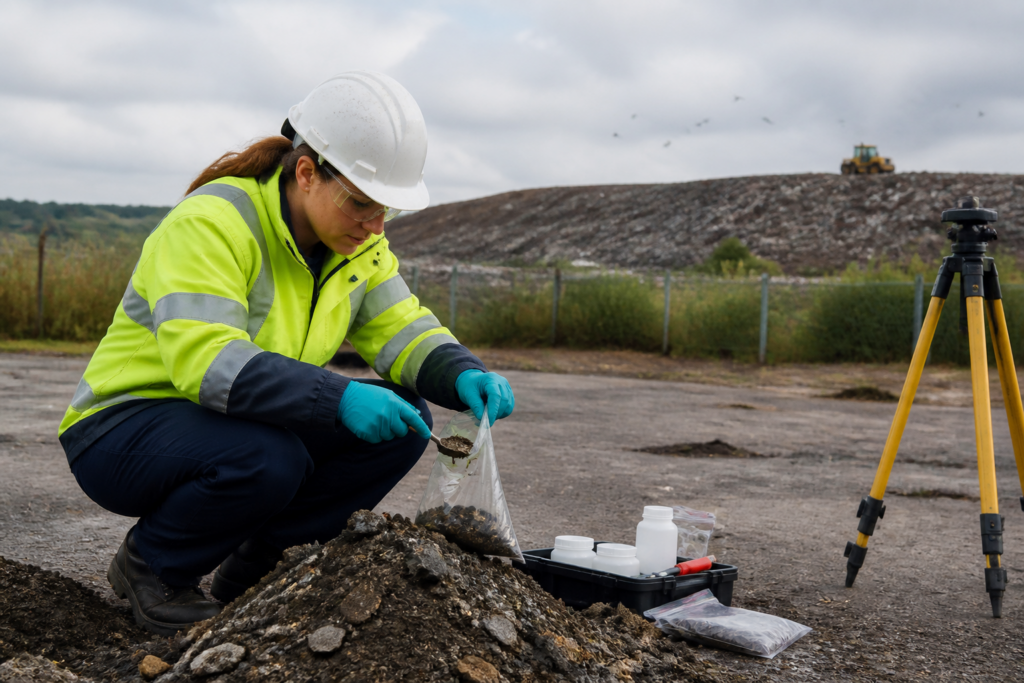
A technically capable laboratory cannot correct an unrepresentative sample. The producer, secondary producer or landfill operator may undertake sampling and testing, but the submitted material must represent the waste stream being described. The Environment Agency directs waste holders to the sampling provisions in WM3 when developing a sampling plan.
This has practical consequences for procurement. A laboratory should be contacted before field sampling to confirm container requirements, preservation and transport arrangements, sample mass, turnaround assumptions and any preparation it can undertake. The landfill guidance specifically advises checking whether the laboratory can crush material below 4mm or 10mm before samples are taken. This is especially relevant to stony soils, brick-rich fill and demolition-derived material, where physical variability can otherwise undermine the test programme.
Visible materials that are unsuitable for laboratory testing may need to be screened or sorted. That approach must be justified and documented in the basic characterisation, and the removed fraction cannot simply disappear from the assessment: it may require separate classification and an alternative recovery or disposal decision. Gypsum, asbestos and organic material also need specific consideration because each can affect the permitted route and the evidence required.
Different rules apply to regular and variable wastes
For a genuinely consistent waste produced by the same defined process, initial basic characterisation can establish the composition range, variability and key parameters for later compliance testing. The producer must revisit that basis if inputs or the process change, if the waste’s characteristics may have altered, or if verification at the landfill identifies a discrepancy.
That flexibility does not extend to one-off, mixed or inconsistent material. Where waste is not regularly generated, each batch must be characterised. For heterogeneous project arisings, a lower-cost sampling plan designed around an assumed single waste stream may prove false economy if the landfill operator cannot rely on it.
Actions for waste holders and project teams
- Confirm the disposal question first. Establish the likely landfill class and discuss the intended acceptance route with the receiving operator before commissioning tests.
- Separate the scopes of work. Ask whether classification, basic characterisation and WAC analysis are each required, rather than ordering a generic “WAC test”.
- Check the laboratory’s relevant accredited capability. Obtain confirmation that the required methods and sample types can be tested to an accredited standard.
- Agree a representative sampling plan. Account for volume, material variability, particle size and visibly distinct fractions.
- Keep the evidence together. Retain laboratory certificates alongside the classification assessment, sampling rationale, treatment information and basic-characterisation record.
The March 2025 update is a reminder to review current landfill guidance, rather than evidence of a new standalone testing regime. Its enduring practical message is clear: sound landfill acceptance depends on a sequenced evidence trail. Classification determines what the waste is; basic characterisation explains the waste and its intended route; and appropriately scoped, accredited testing provides the analytical evidence needed for acceptance.
Sources and further reading
- Environment Agency (GOV.UK) — Dispose of waste to landfill
- Environment Agency and Defra (GOV.UK) — Classify different types of waste: your legal responsibilities
- Environment Agency (GOV.UK) — Landfill operators: environmental permits — Accept the right waste
- United Kingdom Accreditation Service — Accreditation standards