


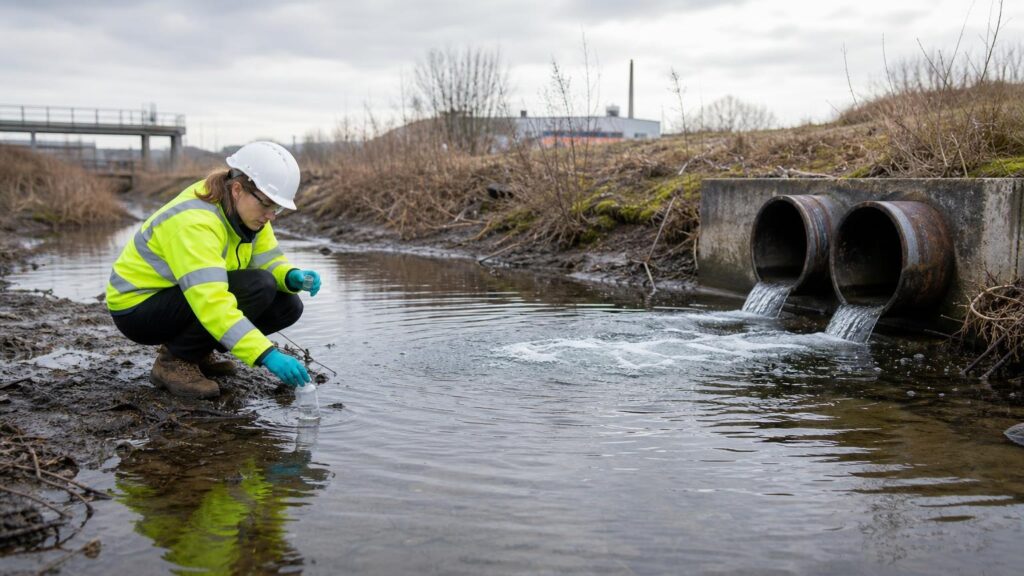
The UK government’s PFAS Plan is now in place, with the policy paper most recently updated on 17 August 2026. The August update itself was limited — it amended timetable information in the action table — but the plan as a whole matters for contaminated-land work because it sets out a clearer direction for how legacy PFAS risks are expected to be identified, prioritised and managed.
For developers and landowners, this does not mean that every brownfield site suddenly needs PFAS testing. It does mean that PFAS history is becoming harder to treat as a peripheral issue where there is a credible source and pathway.
Why PFAS is different from many established contaminants
Per- and polyfluoroalkyl substances (PFAS) are a large group of chemicals valued for properties such as resistance to heat, water and oil. Their persistence and mobility are also what make them difficult from an environmental risk perspective.
The government’s plan notes that PFAS can move between environmental compartments including land and water, and that monitoring has detected PFAS in approximately 80% of surface-water samples and approximately 50% of groundwater samples within the monitoring data described by the plan. Those figures should not be read as meaning that every waterbody has the same risk; they illustrate how widespread the compounds are within monitored environments.
The important site-specific question remains whether a plausible source, pathway and receptor linkage exists.
What the plan says about legacy contaminated land
Several actions are directly relevant to land contamination. The Environment Agency is using outputs from a national risk-screening programme to help relevant authorities understand and prioritise PFAS-related risks. The plan also commits to updated information and guidance for local authorities carrying out contaminated-land responsibilities under Part 2A of the Environmental Protection Act 1990 where legacy PFAS may be present.
More significantly for development and remediation work, the plan includes an action to develop technical guidance for regulators and industry on legacy PFAS contamination across relevant regimes. The government identifies planning, voluntary remediation, environmental permitting and Part 2A as areas where a more consistent practical approach is needed, with technical guidance expected by 2027.
That is a useful signal for project teams: the technical and regulatory framework is still developing, so site decisions need to be evidence-led and proportionate rather than based on a single generic screening number or assumptions imported from another jurisdiction.
When should PFAS be considered in a Phase 1 review?
PFAS should be considered where the historical evidence gives a credible reason to do so. Firefighting foams are a particularly important source identified in the government’s plan. In practice, histories involving fire-training activities, airports and airfields, military use, fire stations, fuel-handling areas or facilities where fluorinated firefighting foams may have been stored or used can justify closer review.
That does not automatically mean an intrusive investigation is required. A good Phase 1 Desktop Study should first establish the historical context, potential source areas, hydrogeological setting and receptors. The conceptual site model can then determine whether PFAS represents a plausible pollutant linkage that needs further work.
Groundwater deserves particular attention
PFAS mobility means groundwater can be central to the conceptual site model. A source area that is relatively localised at surface can have a wider significance where migration through soil and groundwater creates a pathway towards abstractions, surface water or other sensitive receptors.
If intrusive work is justified, the investigation needs to be designed for the PFAS question rather than simply adding PFAS to a generic laboratory schedule. Sampling materials, cross-contamination controls, detection limits, analyte selection, groundwater conditions and waste handling can all affect whether the results are useful.
EnviroSolution’s PFAS service covers investigation, assessment and remediation support for PFAS-impacted ground and groundwater. Where wider contamination risks are present, this can be integrated with Phase 2 Ground Investigation and contaminated-land work rather than treated as an isolated laboratory exercise.
Firefighting foam remains an active regulatory issue
The plan also confirms ongoing work under UK REACH to consider restrictions on PFAS in firefighting foams. The Health and Safety Executive has developed the evidence base for a potential restriction and the government expects the regulatory decision process to continue into 2027.
For existing sites, proposed restrictions on future use do not remove the legacy question. Historical releases can remain relevant long after the original activity has stopped, which is why site history and groundwater pathways matter so much in contaminated-land assessment.
What we would do on a live project
Our starting point would be proportionality. We would not recommend PFAS analysis simply because PFAS is receiving regulatory attention. We would look for a credible historical source, understand the site’s geology and hydrogeology, identify the receptors that could matter, and then decide whether further investigation would change a project decision.
That approach is consistent with normal land-contamination risk management: investigate the pollutant linkage that the evidence supports, and design the work around the decision that needs to be made.
If you have a site with a possible PFAS history, you can send the site information, previous reports and plans through our enquiry builder for an initial scope review.