


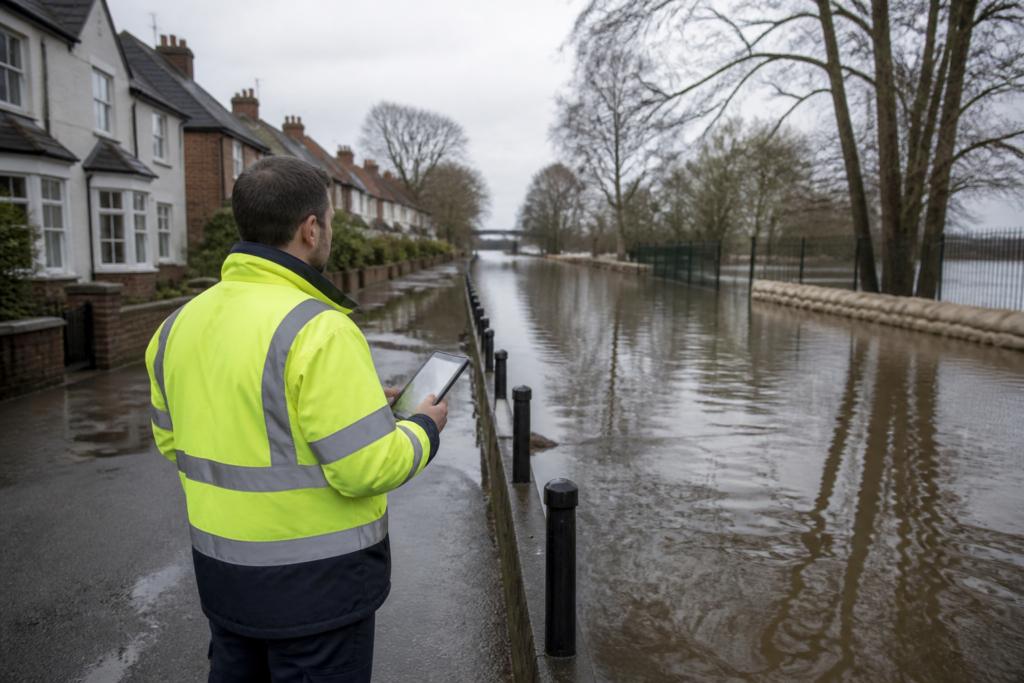
Aviva chief executive Amanda Blanc has warned that homes currently being built in flood-risk areas in England may become uninsurable as flooding becomes more frequent and severe. The comments, reported on 29 September 2026, bring a commercial issue into sharper focus for residential development: a scheme can obtain planning permission and still carry a growing long-term risk to insurance availability, mortgage lending and saleability.
Blanc said England was continuing to build in locations exposed to flooding, including surface-water flooding following intense rainfall on dry ground. She cited estimates that 110,000 homes have been built in flood-risk areas over the last decade and that a further 115,000 could follow over the next ten years if present patterns continue.
This is not a change in planning law, a new insurance rule or a ban on building in flood-risk areas. It is, however, a significant market warning from a major insurer at a time when planning policy already requires decision-makers to consider current and future flood risk over the lifetime of development.
Why the warning matters beyond planning consent
Residential schemes are generally assessed over a lifetime of at least 100 years for flood-risk planning purposes. In England, site-specific flood risk assessments are expected to address risk from all relevant sources, account for climate change and demonstrate how flood risk will be managed throughout that lifetime.
That planning test is essential, but it does not guarantee that household insurance will remain available at an affordable premium decades after completion. Insurers make underwriting decisions using their own assessment of exposure, claims experience, local drainage performance, resilience measures and the changing likelihood of future losses. A development may therefore be policy-compliant at determination stage while still being viewed as increasingly exposed by insurers, buyers and lenders later on.
The potential consequences are material. Where buildings insurance is unavailable, restricted or prohibitively expensive, buyers may struggle to meet mortgage conditions or may discount the price they are willing to pay. This can affect absorption rates, valuations, refinancing, build-to-rent investment decisions and the residual land value used to support an acquisition. For housebuilders and land promoters, flood resilience is becoming an issue for commercial due diligence as well as technical compliance.
A particular gap for post-2009 homes
The warning is especially relevant to newer housing because properties built after 1 January 2009 are outside the scope of Flood Re. Flood Re was designed to help eligible existing households obtain more affordable flood cover while maintaining incentives not to create additional flood exposure through new development. It is currently intended to operate until 2039, with a transition towards a more risk-reflective market.
This does not mean every new home in a mapped flood-risk area will be uninsurable, nor does it mean that older homes are automatically protected. It does mean developers should not assume that the availability of the Flood Re scheme provides a backstop for newly built dwellings. Insurance evidence should be treated as a distinct part of a scheme’s risk profile.
Surface water and residual risk need greater attention
The focus should not be limited to Flood Zones associated with rivers and the sea. Blanc’s comments point directly to surface-water flooding, which can affect sites in Flood Zone 1 and may be influenced by local topography, constrained drainage networks, urban catchments and the cumulative effect of neighbouring development.
Environment Agency guidance already requires flood-risk assessments to consider climate change and, where relevant, assess river, tidal and surface-water sources together. It also expects an appraisal of residual risk, including the implications of flood defences being exceeded, overtopped or breached. For sites where flood storage, pumping, adopted sewers or private sustainable drainage features are integral to the mitigation strategy, long-term operation, maintenance and funding arrangements deserve equal scrutiny.
A drainage strategy that technically controls discharge at the site boundary may not on its own answer wider questions about the resilience of access roads, downstream networks, utility infrastructure or the ability of residents to recover quickly after an event. These matters can become increasingly important to purchasers, managing agents and insurers even where they do not prevent a planning permission being granted.
What developers, lenders and landowners should consider now
- Revisit the baseline: check the age, purpose and limitations of flood datasets used in early site appraisal, including local strategic flood risk assessments and surface-water mapping.
- Test the whole development envelope: assess finished floor levels, access and egress, external areas, substations, drainage assets and critical services rather than concentrating only on habitable rooms.
- Model climate and residual scenarios clearly: explain what happens if defences are exceeded, drainage is temporarily overwhelmed or safe access is affected during a design event.
- Build resilience into the specification early: consider recoverable finishes, raised services, flood-resistant openings, resilient landscaping and practical measures that reduce damage and reinstatement time.
- Seek insurance-market input proportionately: for exposed or strategically important schemes, early engagement with brokers and insurers can identify concerns that a planning-led assessment may not reveal.
- Protect viability assumptions: reflect flood mitigation, management-company obligations, maintenance funding and possible insurance-cost sensitivity in financial appraisals and lender due diligence.
The immediate message is not that all development in areas of mapped risk is unsuitable. National policy still allows proposals where the sequential approach, site-specific evidence and, where applicable, the exception test are satisfied. But the Aviva intervention strengthens the case for treating future insurability as a board-level development risk rather than a matter to be considered only after homes are sold.
For schemes at land-promotion, pre-application or detailed-design stage, the most defensible approach is to align planning evidence, drainage design, resilience specification and commercial risk assessment from the outset. That will not remove flood risk, but it can provide a clearer basis for decisions on location, layout, mitigation, funding and long-term stewardship.