


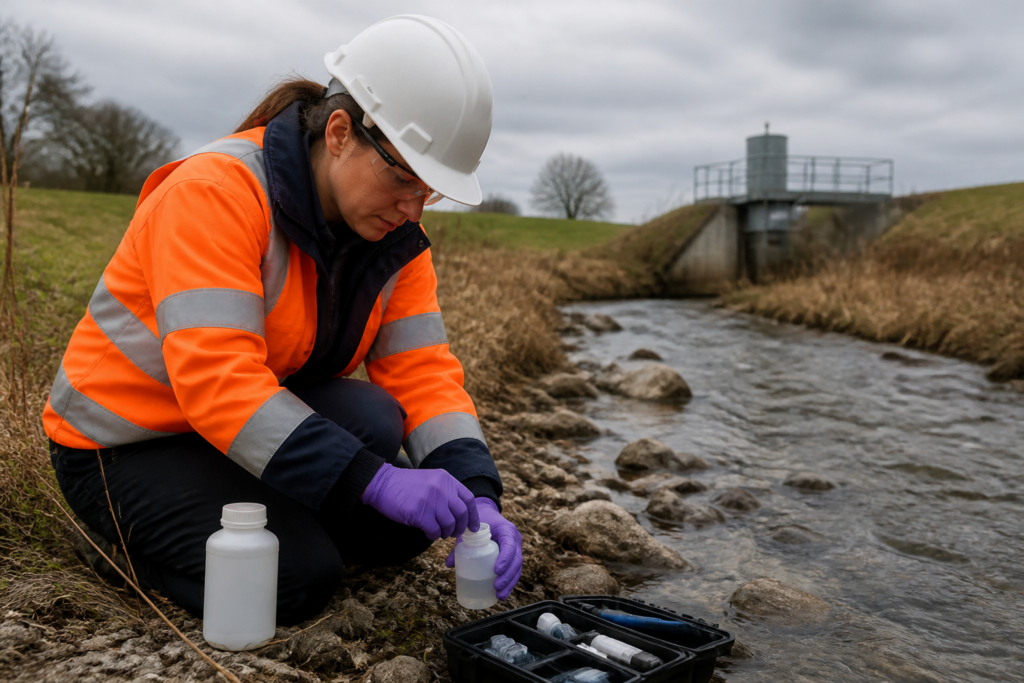
Environment Agency monitoring data obtained through Freedom of Information requests has brought trifluoroacetic acid (TFA) into much sharper focus for English groundwater and surface-water risk assessments. Reporting published on 7 October 2026 states that TFA was detected in 43 of 49 groundwater samples and in all 50 surface-water samples tested by the Agency.
The results are limited in number and are not presented as a nationally representative survey. They should therefore not be used to infer that every aquifer, river catchment or development site has a comparable concentration. Nevertheless, they are a significant early indication that TFA may be more widespread in environmental waters than many conventional contaminated-land and due-diligence investigations have assumed.
What the reported results show
The reported highest groundwater concentration was 10,202 ng/L, at a location near Finchingfield in Essex. The highest reported surface-water result was 6,412 ng/L in the River Ancholme, Lincolnshire. The reporting also states that 42 of the 49 groundwater samples exceeded 100 ng/L, a value used in EU groundwater legislation for certain pesticide metabolites. That comparison is informative but must be treated carefully: it is not a current UK TFA groundwater standard and does not create a direct compliance obligation for English sites.
TFA is a very small, highly mobile fluorinated acid associated with the breakdown of a range of fluorinated substances. Potential contributors can include certain pesticides, refrigerants and industrial chemicals. This matters because the presence of TFA in groundwater may reflect transformed compounds, diffuse catchment inputs, historic releases, off-site migration or a combination of sources, rather than a straightforward release of TFA from the land being assessed.
There is currently no standalone statutory limit for TFA in English groundwater or surface water. The reported findings therefore do not introduce a new automatic trigger for remediation, planning conditions or environmental-permit action. They do, however, add evidence relevant to the professional judgement used in conceptual site models, source screening and proportionate investigation design.
A change in the PFAS due-diligence question
Historically, PFAS enquiries have often focused on identifiable point sources: airports, fire-training areas, fire stations, military facilities, metal finishing, fluorochemical manufacture, waste facilities and sites where firefighting foams may have been used. Those remain important source categories. The TFA results broaden the question.
For sites with groundwater receptors, assessors should now consider whether a PFAS review limited to a conventional list of longer-chain substances is likely to answer the relevant risk question. A risk-based review may need to examine:
- historic and current use of fluorinated pesticides, refrigerants, process chemicals and waste materials;
- nearby industrial, agricultural and wastewater pathways that could create an off-site or diffuse contribution;
- the likelihood of precursor transformation, rather than only direct release of a named PFAS;
- hydraulic connectivity with springs, baseflow-fed watercourses, wetlands, abstractions and private supplies; and
- whether the proposed laboratory method includes TFA at a suitable reporting limit and has robust sampling controls.
This does not mean that TFA analysis is required for every Phase 1 or Phase 2 investigation. A generic addition of TFA to all analytical suites, without a plausible source-pathway-receptor linkage, could generate data that are difficult to interpret and disproportionate to the decision required. The more immediate change is the need to document why TFA has been included or excluded from a PFAS scope, particularly where groundwater is a sensitive receptor or a site has fluorinated-chemical source indicators.
Groundwater conceptual models need to allow for background and migration
TFA creates a particular interpretive challenge for landowners, developers, lenders and operators. Its persistence and mobility mean that an on-site detection may not, by itself, demonstrate that the site is the source. Conversely, the absence of an obvious legacy PFAS operation should not automatically rule out a relevant pathway.
Conceptual site models should distinguish carefully between on-site source evidence, potential upgradient and catchment-scale influences, vertical migration through made ground and superficial deposits, and discharge to connected surface waters. Baseline monitoring, appropriate upgradient locations and repeated sampling may be more valuable than a single isolated result where there is uncertainty over origin, seasonality or groundwater flow direction.
This approach is consistent with Environment Agency groundwater risk-assessment guidance, which requires assessments to identify sources, pathways and receptors, consider possible hydraulic continuity with surface water, and refine the conceptual hydrogeological model as information improves. Monitoring requirements under an environmental permit remain site- and risk-specific; the reported TFA data do not alter permit conditions automatically.
Private supplies and water-resource receptors
The findings are also relevant where a project lies near private water supplies, potable abstractions or groundwater resource areas. The Drinking Water Inspectorate advises local authorities to consider likely PFAS catchment sources, including unknown sources where potential exists, and to use intelligence from land-pollution teams and water companies in private-supply risk assessments.
Where PFAS are found in a private supply, any health-risk conclusion depends on the substances identified, concentrations, use of the supply and treatment performance. It should not be assumed from these environmental monitoring results that a drinking-water supply is unsafe. Equally, conventional treatment cannot simply be presumed to manage all PFAS equally: the Inspectorate notes that short-chain carboxylic-acid PFAS are among the more challenging compounds to remove.
Actions to consider now
- Refresh PFAS screening criteria. Review whether TFA, relevant precursors and transformation pathways should be considered for sites with credible fluorinated-chemical, agricultural, waste or wastewater linkages.
- Check analytical fitness. Confirm that proposed methods specifically cover TFA, with appropriate limits of quantification, sample handling and laboratory accreditation or demonstrated competence.
- Strengthen lines of evidence. Pair chemistry with borehole construction records, groundwater levels, flow direction, drainage information, land-use history and off-site source review.
- Protect transactions from ambiguity. For acquisitions, refinancing and redevelopment, record the basis for any decision not to investigate TFA and identify residual uncertainty where data are unavailable.
- Watch the regulatory evidence base. The Drinking Water Inspectorate says the Environment Agency’s PFAS multi-criteria GIS prioritisation map is expected to be available to public-sector bodies in England by the end of 2026. That may improve the information available to local authorities and other public bodies when prioritising PFAS risks.
The key message is not that TFA has become a universal regulatory contaminant-of-concern overnight. It is that the first reported Environment Agency groundwater results provide a timely reason to make PFAS assessments more chemically and hydrogeologically specific. For higher-risk sites, a defensible scope now needs to consider persistent breakdown products and off-site catchment pathways as well as familiar legacy PFAS point sources.
Sources and further reading
- Greenpeace UK – Toxic ‘forever chemical’ linked to reproductive harm found in almost all rivers and groundwater tested in England
- Environment Agency – Groundwater risk assessment for your environmental permit
- Drinking Water Inspectorate – Poly and Perfluorinated Alkyl Substances (PFAS)
- Environment Agency – Developing thresholds for managing PFAS in the water environment