


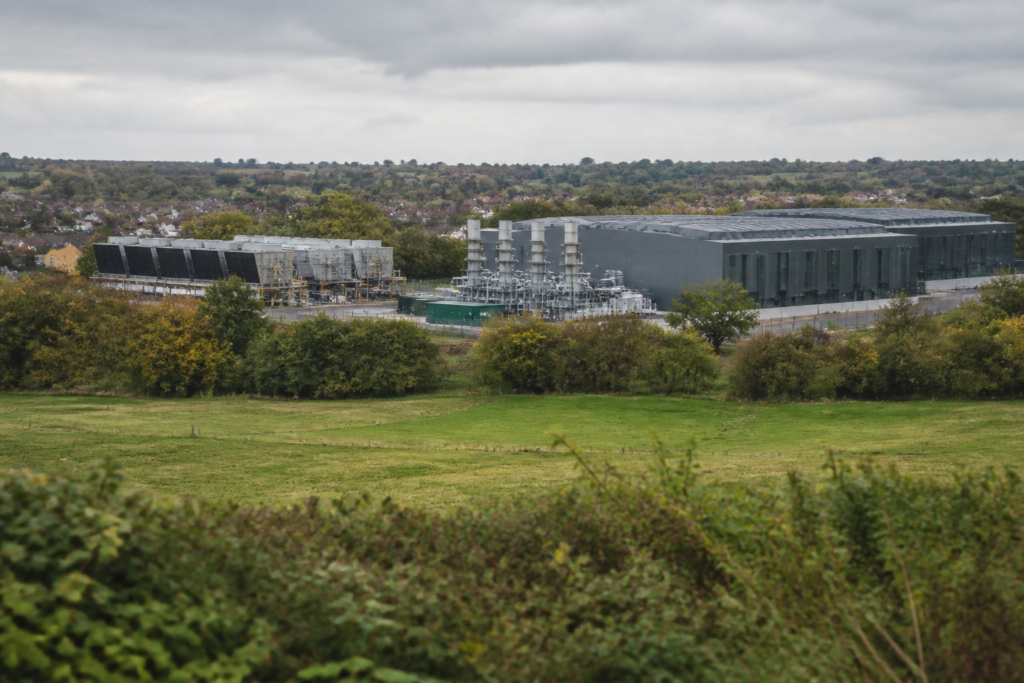
Environmental evidence for data-centre schemes is moving well beyond the building envelope. A new objection from Stoke Poges Parish Council to the Pinewood Nurseries outline application in Buckinghamshire puts the proposed energy strategy at the centre of the planning case: a 49.5MW gas-fired energy centre, comprising 11 gas engines, alongside 43 diesel standby generators.
The representation, published on 16 September 2026, concerns application PL/26/06414/OA for land at Pinewood Nurseries, Wexham Street. The application presents alternative redevelopment options, including up to 40,500 square metres of data-centre floorspace with an energy centre and substation. It remains an application, not a permission, and the Parish Council’s objection is not a determination by Buckinghamshire Council.
Its importance lies in the level of evidence being sought where on-site fossil-fuel plant may provide more than occasional resilience. The Parish Council says the applicant’s documents indicate that unrestricted firm grid capacity may not be available for around ten years, meaning the gas engines could initially be the data centre’s principal power source rather than conventional emergency equipment.
Scottish EIA direction adds a significant policy signal
The Pinewood case coincides with a separate but relevant development in Scotland. On 16 September 2026, the Scottish Government announced a planning direction requiring an Environmental Impact Assessment for all new data-centre applications with a power capacity exceeding 50MW.
That direction applies in Scotland; it does not create an equivalent automatic EIA requirement in England and does not determine the Pinewood application. In England, whether an Environmental Impact Assessment is needed for Schedule 2 development remains a screening matter for the local planning authority, based on whether the project is likely to have significant environmental effects. Developers can also choose to submit an Environmental Statement.
Nevertheless, the timing is notable. Scotland’s intervention reflects an expectation that large data-centre proposals should assess environmental effects systematically from the outset. The Pinewood proposal, with its stated 49.5MW electrical generation capacity, sits just below the Scottish direction’s stated threshold, but it illustrates why capacity figures alone do not settle the environmental questions. Operating hours, fuel use, thermal input, emissions, stack design, simultaneous operation and the duration of fossil generation all matter.
What the Parish Council wants assessed
The objection does not claim that every potential effect will occur. Instead, it asks Buckinghamshire Council to test whether the submitted evidence uses realistic and suitably conservative assumptions, particularly for nearby homes, Wexham Park Hospital and ecological receptors.
The main requests include:
- clear assumptions on how many gas engines may run at once, their annual hours and whether overnight operation is anticipated;
- air-quality modelling for credible high-use scenarios, including short-term and long-term exposure at sensitive locations;
- an assessment of combined noise from gas engines, diesel generators, cooling equipment, fans, ventilation and other plant;
- specific testing and emergency-operation scenarios for the 43 diesel generators, including the number that could run simultaneously;
- consideration of distinctive acoustic characteristics, such as tonal, intermittent or impulsive sound, rather than relying solely on overall noise levels;
- assessment of nitrogen deposition and other potential ecological effects from combustion emissions;
- annual and lifetime greenhouse-gas estimates for the proposed gas-fired generation period; and
- an explanation of lower-carbon alternatives and a defined, enforceable route away from on-site gas generation once suitable grid capacity is available.
A recurring point is that essential operating assumptions should not be left solely within technical reports. Where a scheme relies on restrictions to make its effects acceptable, the Parish Council argues that they should be translated, where justified, into precise planning conditions or obligations.
Permitting does not remove planning questions
For English schemes, combustion plant may also need assessment under the Environmental Permitting Regulations. Environment Agency guidance confirms that medium combustion plant and specified generators can require an environmental permit, with controls principally focused on emissions to air, including nitrogen oxides, sulphur dioxide and dust. Whether a particular installation is in scope depends on technical details, including rated thermal input, aggregation, plant type, fuel and relevant exclusions.
That separate regime should not be treated as a substitute for planning evidence. An air permit does not by itself resolve land-use issues such as the appropriateness of a location, local amenity, operational noise, landscape effects, the relationship with sensitive receptors, cumulative development or the planning weight of prolonged fossil-fuel reliance. Equally, planners should avoid duplicating regulatory controls without a clear land-use reason.
Practical implications for promoters and landowners
The Pinewood objection shows where application teams may face the closest scrutiny when grid capacity is constrained. A generic backup-power narrative is unlikely to be enough if engines could operate routinely or for extended periods.
Before submission, developers should align the energy strategy, environmental assessments and draft controls around one transparent operating envelope. That should identify normal operation, testing, commissioning, grid-outage and worst-case scenarios; distinguish electrical MW from thermal input; and demonstrate that assumptions are consistent across air quality, noise, carbon, ecology, transport and cumulative-effects work.
Noise assessments should contain traceable sound-power data and realistic operating profiles for engines and cooling plant. Air-quality work should explain source parameters, emissions assumptions, meteorological inputs, receptor selection and any interaction with other nearby combustion sources. Carbon reporting should separate construction impacts from operational emissions and set out the consequences if the anticipated grid-connection timetable slips.
For authorities and consultees, the immediate question is not whether all data centres require the same response. It is whether the evidence reflects the actual proposed energy model. Where an energy centre is intended to bridge a short, tightly controlled connection delay, the assessment may look very different from one designed to provide primary power for years.
The Pinewood application will therefore be a useful English planning test of a growing issue: whether large digital infrastructure can be considered sustainably where firm grid power is unavailable at the point development is proposed. Scotland’s new EIA direction does not answer that question for England, but it makes the direction of travel clear: environmental effects from power supply are becoming inseparable from the data-centre planning case.