


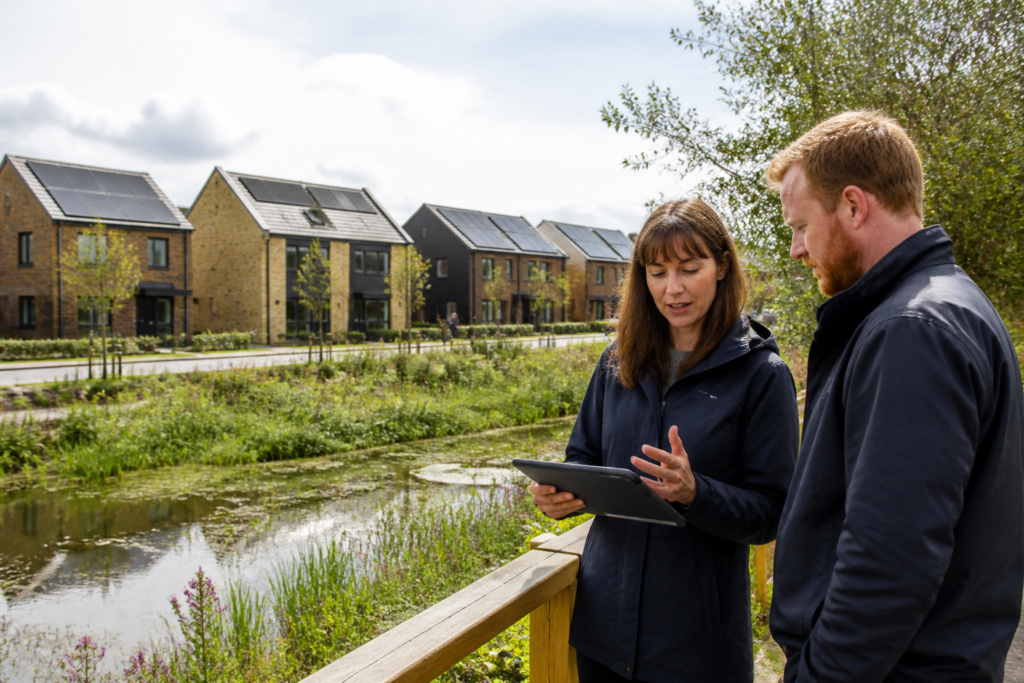
The UK Green Building Council (UKGBC) formally launched its Regenerative Places Framework for Housing on 16 September 2026, setting out a voluntary, place-based approach for new housing and retrofit projects. The framework is intended to help organisations look beyond individual building performance and consider how homes and neighbourhoods affect nature, climate resilience, energy, health, local economies and community life over the long term.
A further online launch webinar is scheduled for 6 October 2026, from 10:00 to 11:00. UKGBC says the session will introduce the framework’s core principles, discuss lessons from its development and hear from practitioners applying regenerative approaches in live projects.
A framework rather than a new compliance requirement
The principal point for developers, councils and housing providers is that this is not a new statutory standard, planning requirement or building-control regime. It does not alter the Building Regulations, automatically create a new planning validation requirement, or replace local-plan policy, environmental assessment or technical evidence.
Instead, UKGBC presents the document as a structure through which organisations can connect existing standards, policies and project decisions. It is intended to broaden the definition of value used in housing delivery: moving from a focus on mitigating adverse effects towards creating lasting benefits for people, places and ecological systems.
This distinction matters. Teams should not describe the framework as compulsory compliance, but it may become a useful voluntary benchmark where clients want to demonstrate a more rounded approach to sustainability, social value, design quality and long-term stewardship.
What has been introduced
The framework sets out a regenerative vision for housing, supported by nine Dimensions of Place, six major transitions and practical pathways for applying the approach across project stages. It also includes project examples, commentary on policy conditions and a charter intended to support organisations implementing regenerative principles in practice.
Its scope is deliberately wider than operational energy or carbon reporting. UKGBC links housing decisions to access to nature, community connection, health and wellbeing, resilience to changing climate conditions, resources and local value. The framework applies to both new development and existing-home retrofit, recognising that neighbourhood outcomes are shaped by investment in the existing housing stock as well as by new construction.
UKGBC developed the work through engagement with built-environment stakeholders, local workshops, research and community input. That background is significant: the framework encourages project teams to consider local conditions and relationships rather than treating every housing scheme as a repeatable technical product.
Who is likely to be affected
The immediate audience includes housebuilders, developers, registered providers, local authorities, investors, planners, designers, contractors, asset managers and organisations involved in the stewardship of neighbourhoods. Community groups and public-service bodies may also find it relevant where they influence the longer-term outcomes of regeneration and retrofit programmes.
For local authorities, the framework could provide a common language for bringing together housing, planning, climate adaptation, public health, green infrastructure, transport and regeneration teams. It may be particularly helpful at area-plan, estate-renewal and retrofit-programme stages, where individual interventions can otherwise be assessed in isolation.
For development teams, the change is less about adding a single report at the end of the design process and more about setting an early brief. The framework’s emphasis on collaboration and stewardship means that landowners, delivery partners and future managers should be involved earlier when decisions are still capable of influencing layout, landscape, infrastructure, tenure, maintenance and community facilities.
Practical implications for live projects
Organisations considering use of the framework should begin by reviewing where their current processes already address its objectives and where important connections are missing. In practice, this could mean bringing together evidence that is commonly commissioned separately, such as energy and overheating assessments, flood-risk and drainage work, biodiversity strategy, landscape proposals, transport planning, health or social-value commitments, and estate-management plans.
- At site-selection and masterplanning stage: map local environmental systems, infrastructure constraints, community assets and climate risks alongside commercial viability.
- At design stage: test whether energy, water, biodiversity, public realm, access and health objectives reinforce one another rather than compete for space or budget.
- For retrofit programmes: consider neighbourhood-level sequencing, supply-chain capacity, resident engagement and local energy-network implications, not only property-by-property measures.
- At procurement stage: set measurable expectations for collaboration, circular resource use, community engagement and handover information.
- After completion: establish stewardship arrangements and proportionate indicators that can show whether intended outcomes continue beyond practical completion.
The appropriate evidence will remain scheme- and location-specific. A framework-led narrative should therefore be supported by credible technical assessments and a clear explanation of how local feedback has influenced decisions. It should not be used to make unsupported claims of environmental or social benefit.
Relationship with planning policy
The framework arrives as national planning policy in England continues to frame sustainable development around social, economic and environmental objectives, including healthy communities, climate mitigation and adaptation, biodiversity and prudent resource use. It may help applicants and councils organise a coherent response to those overlapping objectives, particularly on large or complex sites.
However, its use does not remove the need to meet applicable national policy, local-plan requirements, planning conditions or other statutory duties. Nor does it guarantee planning permission. The most credible use will be where a project team can show that the framework has informed genuine choices, rather than being appended as a retrospective sustainability statement.
Next steps
Housing organisations should download the final framework, identify a suitable pilot project or programme and compare its principles with existing briefing, governance and reporting processes. Councils may wish to discuss it across service areas before deciding whether it can inform design review, development briefs, regeneration strategies or retrofit delivery.
For consultants and project teams, the opportunity is to turn broad place-based aspirations into an auditable delivery plan: clear responsibilities, early engagement, relevant evidence, realistic performance measures and a route for monitoring outcomes after handover. UKGBC’s framework is voluntary, but it provides a timely reference point for clients seeking to make housing investment deliver wider and more durable local value.