


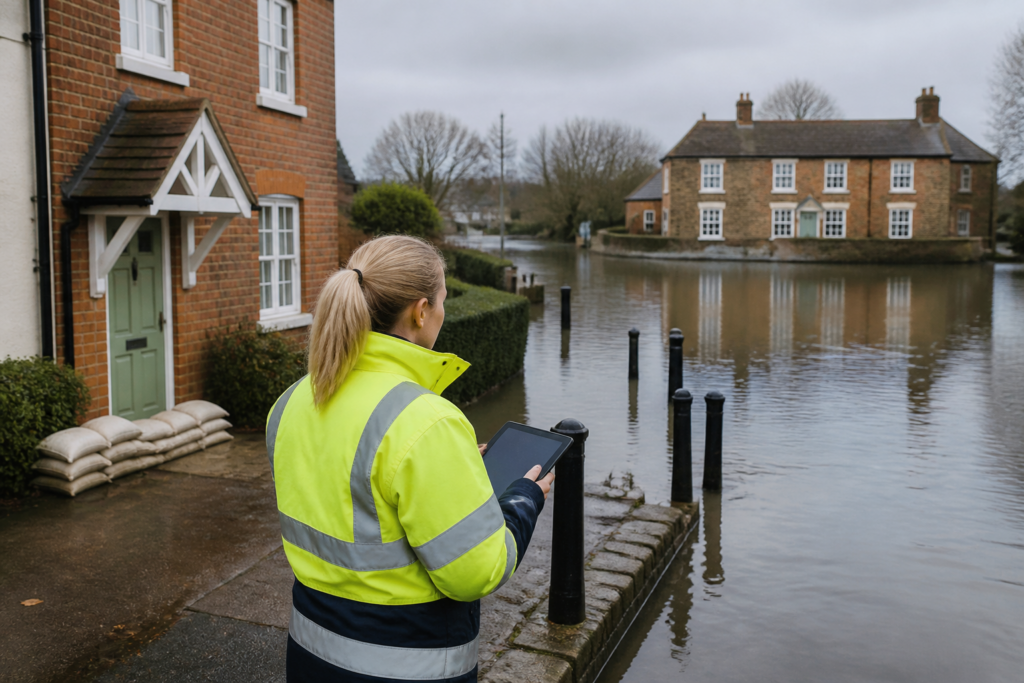
Defra and Flood Re have announced a new pilot programme for Flood Performance Certificates (FPCs), aiming to give householders and the wider property market a clearer, more consistent picture of a home’s flood exposure and resilience.
Announced on 13 October 2026, the initiative is not a new legal certificate, planning requirement or insurance entitlement. It is a pilot-led programme designed to test whether a standard assessment can reliably show how a property may perform in a flood, what measures are already in place and where further resilience work could reduce damage and recovery time.
Work on initial pilots is due to begin before the end of 2026, with additional testing planned through 2027 and beyond. The stated focus is homes in England, beginning with real-world use cases connected to property flood-resilience activity and potentially extending into wider housing-market, insurance-claim and new-build contexts.
A standard record of flood resilience
The proposed certificate is intended to perform a role broadly comparable with an Energy Performance Certificate, but for flood resilience rather than energy use. It would bring together information that is currently often dispersed between flood-risk reports, insurance records, survey evidence, planning documents, household knowledge and installers’ paperwork.
Early proposals envisage a Flood Performance Rating that separates key factors affecting performance. These include a property’s flood exposure, its physical characteristics and its resistance or resilience measures. A useful assessment could therefore distinguish between the likelihood and depth of flooding at a location, the vulnerability of the building itself, and the practical steps taken to prevent water entering or to limit damage if it does.
Examples of measures that may be reflected include demountable barriers, flood doors, raised electrical services, non-return valves, water-resistant finishes and floor finishes that can be cleaned and reinstated more readily after inundation. The precise scoring method, evidence requirements, certificate format and responsibility for assessment remain matters for testing through the pilots.
What has changed — and what has not
The significant change is the move from policy development and prototype work into a live pilot phase. Flood Re has previously developed a roadmap and supporting work on scoring methods and data standards; the forthcoming trials will test whether those approaches are understandable to householders and credible to insurers, lenders and other users.
There is no indication that homeowners will be compelled to obtain an FPC, that a certificate will be mandatory at sale or remortgage, or that it will replace flood-risk assessment for planning. Nor does the announcement create a requirement for insurers to offer reduced premiums, cover or excesses where resilience measures are recorded.
Instead, the intended direction is to make verified resilience information easier to recognise. Flood Re says the programme could support insurance affordability and availability where action taken is sufficient to alter an insurer’s own assessment of risk. That distinction matters: any insurance outcome will continue to depend on the insurer, the policy terms, the property’s exposure and the quality and effectiveness of the installed measures.
Implications for property owners and occupiers
For householders in pilot areas, the practical value may be a more structured route from awareness to action. A certificate could identify whether existing measures are incomplete, poorly evidenced or unsuitable for the anticipated flood conditions. It may also help owners retain a record of improvements when selling, refinancing or renewing insurance.
However, owners should not assume that any product marketed as flood protection will automatically improve a future rating. Evidence of specification, installation, maintenance and suitability is likely to be important. Temporary resistance measures also rely on warning time and correct deployment, while resilience measures should be selected with realistic flood depths, duration, contamination and safe recovery in mind.
Considerations for lenders, insurers and the housing market
Lenders and insurers have long had to interpret inconsistent property-level information. A credible common data structure could reduce uncertainty by recording both installed measures and the evidence supporting them. This may be particularly valuable where a home has been improved after a flood, through a property flood-resilience grant or under an insurer-led reinstatement programme.
For the housing market, FPCs could also make resilience more visible during purchase and due diligence. That does not mean the certificate should become a substitute for proportionate professional advice. A buyer, lender or surveyor may still need to review flood history, official mapping, surface-water pathways, drainage constraints, residual risk from defences and the maintenance obligations attached to any property-level measures.
What developers, designers and environmental consultants should consider now
The pilot programme has relevance beyond existing homes. Flood Re expects testing to explore potential use in new-build construction, while earlier development work has considered how resilience information can be integrated into the building and planning process.
Developers working in areas affected by river, sea or surface-water flooding should therefore consider whether their design and handover records can demonstrate the intended performance of flood-resilient measures over the life of a dwelling. This includes retaining clear evidence of finished floor levels, resilient materials, service locations, drainage interfaces, resistance products, maintenance responsibilities and occupier instructions.
Environmental and design teams should avoid treating an eventual FPC as a route around the sequential approach, exception test or site-specific flood-risk assessment required through planning policy. The certificate concept concerns property performance and communication of resilience; it does not change the need to avoid inappropriate development in areas at risk of flooding or to manage residual risk through sound site layout and design.
Next steps
Organisations involved in residential development, retrofit, lending, surveying, insurance and property flood resilience should monitor the pilot design and published findings during 2026 and 2027. The key questions will be whether assessments can be delivered consistently, what evidence is accepted, how ratings deal with different flood mechanisms and whether the resulting information meaningfully influences household decisions and market practice.
For now, the announcement is best understood as an important market-development step rather than a new compliance regime. Its longer-term value will depend on robust assessment standards, clear consumer communication and genuine recognition of well-designed, properly maintained resilience measures.