


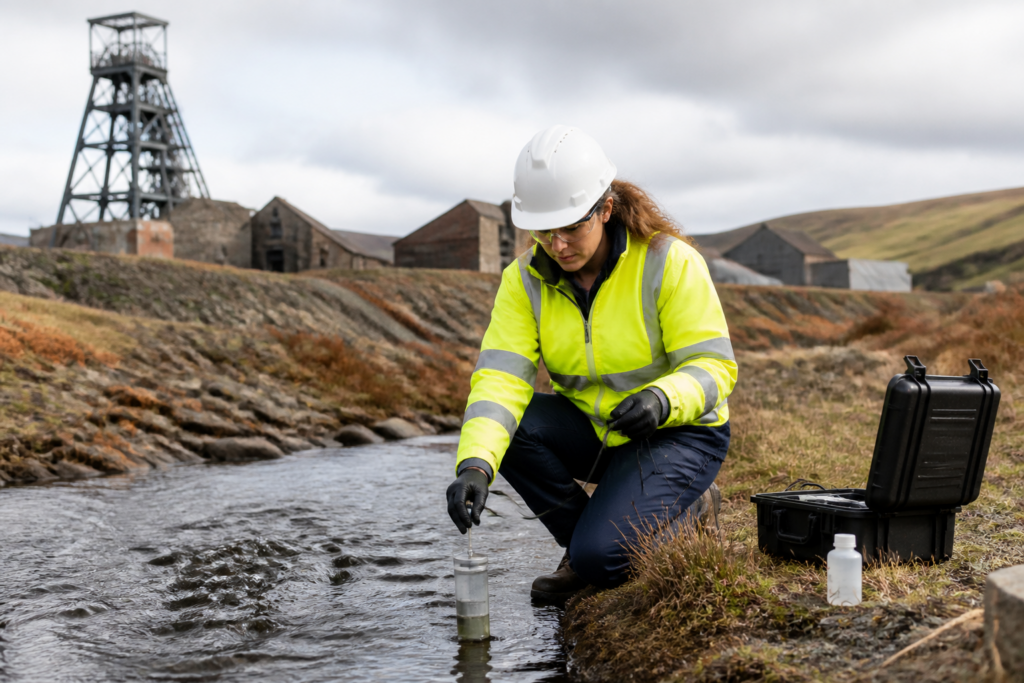
The Mining Remediation Authority (MRA) has opened a new Construction, Environmental & Technical Professional Services Framework, creating a potential £11.28 million pipeline of specialist consultancy work connected with the legacy impacts of mining across Great Britain.
The procurement, reference CA18/5956, is an open framework with an estimated value of £9.4 million excluding VAT. It is intended to run from 21 June 2027 to 20 June 2031, subject to the procurement timetable. The tender notice was published in late September, with the opportunity highlighted by British Water on 6 October.
This is a procurement exercise rather than a new legal requirement for developers, landowners or operators. Its significance lies in the MRA’s decision to assemble longer-term external capacity across mine-water management, environmental assessment, land stability, ecological work and project delivery.
A broader framework for historic mining risks
The framework replaces and expands the MRA’s previous Engineering Services approach. It brings together four service areas that reflect the interconnected nature of mine-legacy work: engineering and treatment infrastructure; ecology and environmental services; treatment optioneering; and planning, commercial and delivery oversight.
The largest element is Lot 1, valued at £7.2 million including VAT. It covers scoping, feasibility, design, supervision and project management for mine-water treatment schemes, civil and structural interventions, asset-related work and associated investigations.
Lot 2, valued at £1.68 million including VAT, seeks multidisciplinary ecology and environmental expertise. Its scope includes surveys, environmental assessment, monitoring, environmental management and regulatory-compliance support. Specialist sub-lots cover ecological survey and reporting work, alongside environmental monitoring, auditing, mine-gas and mine-water investigations, and technical advice.
Lot 3 is directed at treatability services, including laboratory, field and pilot-scale assessment of passive, semi-passive and active mine-water treatment options. This is a notable feature because it creates a defined route to bring treatment-process expertise into option development before major capital commitments are made.
Lot 4 covers planning and consents, environmental and social cost-benefit analysis, project and programme management, construction oversight, cost management and commercial advice. The inclusion of these disciplines recognises that remediation delivery depends on planning, consenting, affordability and contract administration as well as sound technical design.
What the tender indicates
The MRA’s business plan already identifies mine-water quality, recovering water levels in former deep mines, coal-tip safety and metal-mine remediation as continuing priorities. It also states that the Authority is monitoring more complex and saline mine waters from former English deep mines, and will design and build new treatment schemes where justified.
The new framework therefore points to sustained demand for joined-up technical teams rather than isolated reports. Consultants able to connect hydrogeology, geotechnics, civil engineering, ecology, contaminated-land thinking, treatment design and regulatory engagement are likely to be well placed.
It also reinforces the value of evidence that can move a project through successive stages: baseline monitoring, conceptual models, feasibility work, optioneering, pilot trials, design, approvals, construction support and performance verification. For environmental consultancies, this may favour partnerships that can provide specialist capability without attempting to deliver every discipline in-house.
The geographical coverage is broad, spanning England, Wales and Scotland. This matters for firms with regional mine-legacy experience, but tenderers should not assume that the published framework value represents committed spend. The MRA’s earlier planning notice makes clear that its estimated value is based on forecast demand and is not a guarantee of work or minimum call-off value.
How the framework will operate
The MRA may place work through direct award where the relevant conditions are met, through requests for quotation, or through a competitive selection process among framework-appointed consultants. Appointment to the framework will therefore provide access to opportunities, but not an assured workload.
The tender is being run as an open procedure and identifies small and medium-sized enterprises as suitable. That should make the opportunity relevant not only to large multidisciplinary practices but also to specialist firms in fields such as protected-species survey, mine-water chemistry, process engineering, ground investigation, environmental monitoring, ecological clerk of works services, NEC supervision and cost consultancy.
The evaluation model gives equal weighting to technical quality and commercial considerations. Tenderers should consequently avoid treating the bid as a simple rate-card exercise. A credible submission will need to show how technical quality, availability, safety management, quality assurance, collaboration and proportionate pricing will work together across uncertain and potentially complex legacy sites.
Actions for prospective suppliers
- Check lot fit carefully. Decide whether to bid for a full lot or a specialist sub-lot, and ensure the proposed scope aligns with demonstrable project experience.
- Build delivery partnerships early. Mine-water schemes and environmental remediation often require coordinated design, monitoring, consenting and construction-stage input.
- Evidence practical capability. Case studies should demonstrate the ability to investigate uncertainty, compare viable options, manage environmental risks and deliver clear decisions for public-sector clients.
- Review capacity through 2031. The framework term is long enough that resource continuity, regional coverage and succession planning may be scrutinised.
- Register and raise queries promptly. The enquiry deadline is 3pm on 26 October 2026; completed tenders are due by 4pm on 6 November 2026.
For local authorities, developers and landowners in former mining areas, the procurement does not alter their own planning, permitting or environmental responsibilities. However, it is a useful market signal: the MRA expects continued work on mine-water management, land and infrastructure damage, environmental monitoring and remediation. Organisations planning projects in affected areas should continue to identify mining-related constraints early and allow sufficient time for investigation, technical design and any required engagement with the Authority.
The MRA currently expects to make its framework award decision on 18 March 2027. Until then, the opportunity remains a live tender rather than an awarded programme of work.