


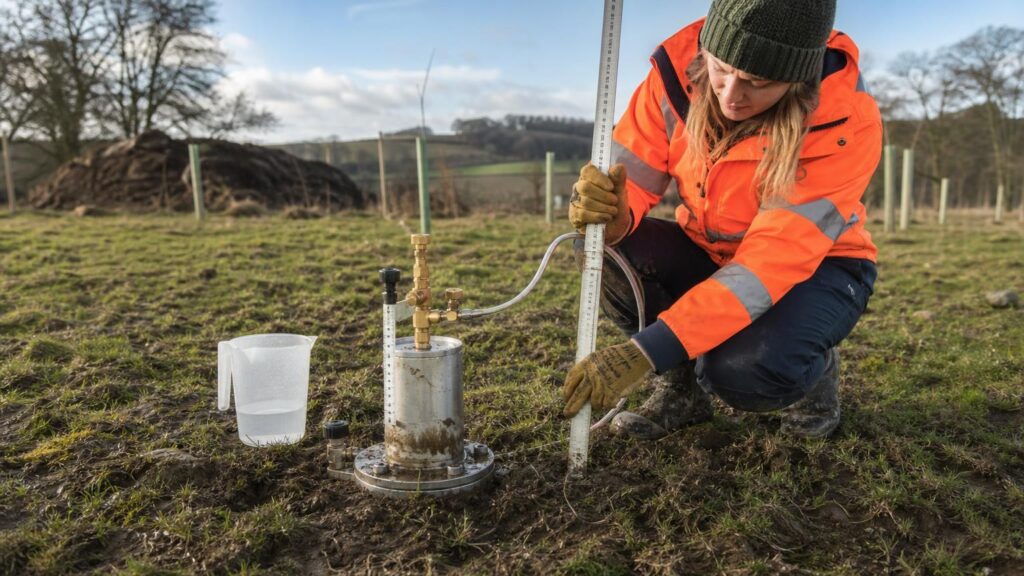
Many developers ask us: “Do I really need an infiltration test?” The answer is often yes. If you’re developing land or submitting a planning application where surface water drainage is a concern, infiltration testing is likely a requirement.
Infiltration testing is used to determine whether a SuDS design like a soakaway is viable. If your site has clay soil or poor drainage, it may not be suitable. But without testing, planners won’t know.
Here are common scenarios where an infiltration test is required:
- New housing developments
- Commercial buildings
- Extensions or outbuildings
- Sites in flood-prone areas
- Any project proposing a soakaway
At EnviroSolution, we handle the full process: digging trial pits, performing BRE 365-compliant testing, and delivering a professional report ready for your planning submission.
Not sure if your site qualifies? Contact our team today to discuss your requirements. We offer expert advice and fast, affordable infiltration testing services to keep your project on track. Click here to book.
When is site-specific infiltration testing usually needed?
Where a drainage strategy proposes infiltration to the ground, the designer normally needs measured evidence that the ground can accept water at a suitable rate. Local planning and Lead Local Flood Authority requirements vary, but BRE 365 testing is widely used to provide the infiltration coefficient used in soakaway and infiltration-system design.
Testing is most useful before the drainage layout is fixed. If measured infiltration is slower than assumed, groundwater is encountered or the ground conditions are unsuitable, the drainage hierarchy and storage strategy may need to change.
What does a BRE 365 infiltration test tell you?
- The measured rate at which water infiltrates into the ground at the test location.
- Whether infiltration drainage is likely to be feasible in the tested ground conditions.
- Data the drainage engineer can use when sizing soakaways or other infiltration features.
- Ground observations that may affect the interpretation, including soil profile and groundwater encountered during the work.
A single assumed permeability value from a geological description is not the same as a site test. The drainage design should use evidence that is representative of the proposed infiltration location and depth.
What should you send before booking?
Provide the site address, red-line boundary, proposed layout, drainage concept if available and any planning or LLFA comments. We can then scope the number and location of tests around the proposed drainage strategy. See our Infiltration Testing service and SuDS, Drainage & Flood Risk service for linked support.