


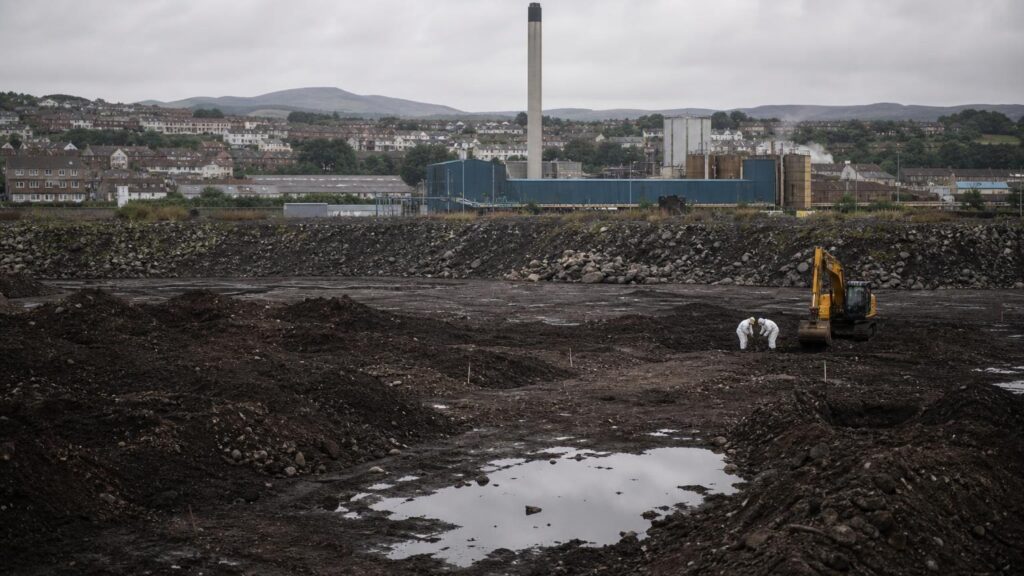
A BBC investigation led by Michael Sheen has brought fresh attention to a difficult part of Britain’s industrial legacy: historic disposal of persistent chemicals and the question of what that legacy may still mean for communities, landowners and development sites decades later.
Buried with Michael Sheen follows concerns first raised by the late farming consultant and environmental campaigner Douglas Gowan. The BBC reports that Gowan identified 14 sites of concern, 12 of them in Wales, and alleged that industrial chemicals including polychlorinated biphenyls (PCBs) had been disposed of at a number of locations linked to historic chemical operations. Residents interviewed for the programme describe serious illnesses, including rare cancers, and want more investigation into whether historic exposure may have played a part.
Those accounts deserve to be taken seriously, but they also need to be described accurately. A cancer cluster or an elevated contaminant concentration does not, by itself, establish that a particular waste site caused an individual illness. Establishing exposure pathways, dose and causation is a much more demanding scientific exercise. The documentary’s importance is that it has put long-running questions about historic contamination back into public view.
Why PCBs remain an issue decades after their use was restricted
PCBs are a family of synthetic chlorinated chemicals that were widely used because they were chemically stable, heat resistant and electrically insulating. They were used particularly in transformers and capacitors, as well as in a range of other industrial applications.
Those same properties create the environmental problem. PCBs can persist for long periods, move between soil, sediment and water, and accumulate in animals and people through food chains. They are listed as persistent organic pollutants under the Stockholm Convention. The International Agency for Research on Cancer classifies PCBs as Group 1 carcinogenic to humans.
That classification is a statement about carcinogenic hazard: PCBs are capable of causing cancer in humans. It is not evidence that every person who has lived near a site containing PCBs has received a harmful dose, nor does it prove the cause of any particular cancer. Site-specific risk depends on concentration, chemical form, how contaminants can move, who or what can be exposed, and for how long.
PCBs are also sometimes described in media coverage as “forever chemicals”. They are highly persistent, but they should not be confused with PFAS. PCBs and PFAS are different chemical families with different histories, uses and analytical requirements. Good contaminated-land work starts by identifying the actual contaminant of concern rather than treating persistent chemicals as one interchangeable group.
The Wrexham sites show why legal terminology matters
One of the locations discussed around the BBC investigation is the Llwyneinion Acid Tar Lagoon and the adjacent former Monsanto chemical waste tip near Ruabon. Wrexham Council issued a statement before the documentary aired confirming that contaminants are present at the sites, while saying that investigations undertaken over many years found they do not meet the legal definition of contaminated land under national law. The council says it continues to inspect the sites, monitor streams and groundwater, and maintain fencing and warning signs.
This distinction can be confusing outside the profession. In everyday language, land containing hazardous substances may be described as contaminated. Under the statutory Part 2A regime, however, “contaminated land” is a defined legal status reached through a risk-based determination. The mere presence of a chemical does not automatically mean a site meets that statutory test.
The same principle applies to development work. A site can require investigation, remediation or planning controls without ever being formally determined as contaminated land under Part 2A. Planning decisions normally look at whether a proposed use can be made suitable and whether unacceptable pollutant linkages exist or could be created by the development.
What this story means for brownfield development
The most useful lesson for developers is not that every former industrial site is dangerous. It is that historic waste handling can leave a complicated footprint that is not always obvious from a present-day site inspection.
A robust Phase 1 Desktop Study should therefore do more than list historic map labels. It should build a picture of how the land and surrounding area were actually used, what substances may reasonably have been handled, where wastes may have gone, and whether there are plausible pathways to people, buildings, groundwater, surface water or ecological receptors.
For a former chemical, manufacturing or waste site, that can mean looking beyond the red-line boundary. Historic tips, lagoons, infilled ground, drains, watercourses, neighbouring works and off-site disposal areas can all be relevant to the conceptual site model. Groundwater and surface-water pathways are particularly important where persistent contaminants may have migrated away from an original source.
Historical records are rarely perfect. Old mapping may identify a works but not the processes carried out inside it. Waste disposal may have taken place on adjoining land rather than within the factory boundary. A site may have changed ownership and use several times. That is why documentary research, regulatory information, previous reports and a sensible understanding of industrial processes need to be considered together.
When a Phase 2 investigation becomes necessary
A desktop study identifies potential pollutant linkages; it does not prove that contamination is present at a harmful concentration. Where the evidence indicates a credible risk, the next step may be a targeted Phase 2 Ground Investigation.
The investigation design should follow the conceptual site model. If PCBs are genuinely plausible, sampling and laboratory analysis need to be selected for PCBs rather than relying on a generic soil suite that may not answer the question. Depending on the site, soil, made ground, sediment, surface water or groundwater may all be relevant media.
The same applies to any persistent contaminant. Sampling locations, depths, laboratory methods and detection limits should be chosen to test the specific source–pathway–receptor relationships identified at Phase 1. A large amount of poorly targeted data is not a substitute for a well-designed investigation.
Health concerns should not be reduced to a planning checkbox
The human stories in the BBC programme are a reminder that contaminated-land work sits behind real communities, not just planning conditions and risk tables. Equally, responsible technical advice must avoid jumping from the presence of a hazardous chemical to a conclusion about individual illness without the evidence needed to support it.
For landowners and developers, the practical response is early due diligence. If a site has a history of chemical manufacture, waste disposal, lagoons, infilling or other potentially contaminative use, finding that out before acquisition or design decisions are fixed gives the project team more options. It also reduces the risk of discovering an expensive problem during earthworks.
EnviroSolution provides contaminated-land consultancy from preliminary risk assessment and historical review through intrusive investigation, remediation strategy and validation. If you are considering a site with an unusual industrial or waste-disposal history, send the available plans and previous information through our enquiry builder and we can review the likely assessment route.
Sources and further reading
- BBC News: Michael Sheen investigates cancer concern around chemical dumping
- Wrexham Council: response on Llwyneinion and the adjacent Monsanto waste tip
- International Agency for Research on Cancer: PCBs and PBBs, Monographs Volume 107
- Stockholm Convention: listing of persistent organic pollutants, including PCBs