


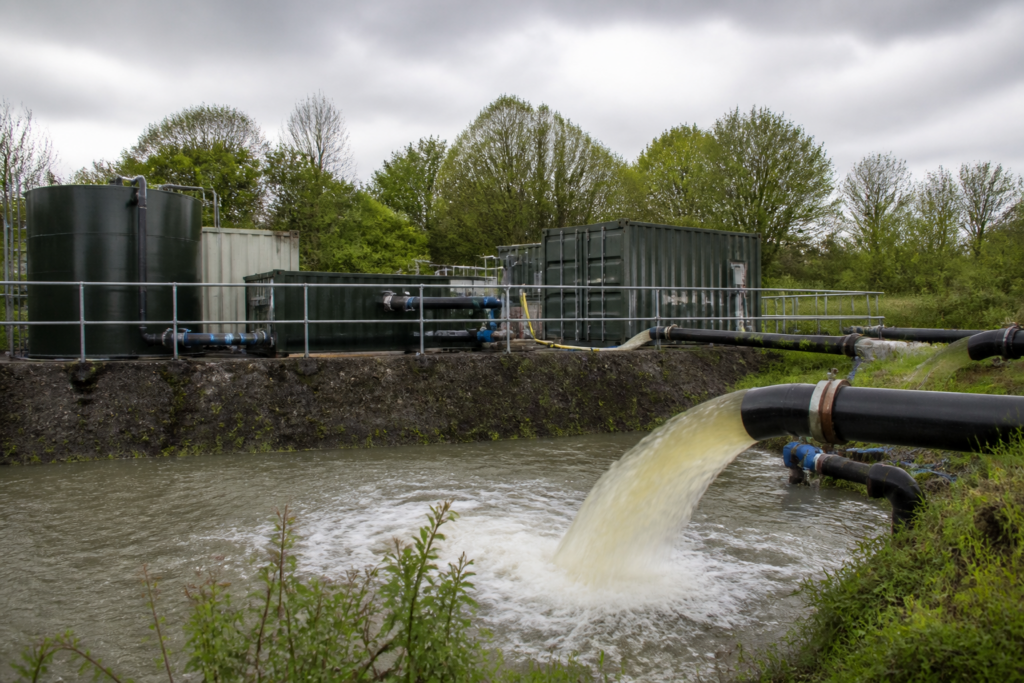
The Mining Remediation Authority (MRA) has moved its West Cannock mine-water investigation towards delivery, identifying J.N. Bentley Limited as the proposed contractor for a pumping test and temporary treatment installation in the Cannock coalfield.
The published contract award notice, dated 26 August 2026, records a value of £1,584,972.76 excluding VAT. At the time of publication, the contract remained marked as pending, with signature estimated for 10 September 2026. The stated contract period runs from 14 September 2026 to 13 September 2027.
The immediate purpose is a three-month pumping test from an existing borehole, at a discharge rate of up to 10 litres per second. However, the project is not simply an investigation into pumping capacity. Sampling from two boreholes has found zinc concentrations that are unsuitable for discharge without treatment, whether to the local watercourse or the sewer network. A temporary mine-water treatment plant is therefore required before the test can proceed.
What has changed?
This is a significant step forward following an earlier procurement exercise that the MRA formally abandoned in February 2026. The Authority said it had received further information from the Environment Agency permitting team and identified additional risks and constraints beyond those allowed for in the original scope. These concerned the level of treatment needed to manage mine water satisfactorily and secure the required environmental permission.
The retendered project has consequently put temporary treatment at the centre of the delivery strategy. The works are expected to encompass pumping and associated infrastructure, treatment to address zinc as well as iron and suspended solids, and a managed discharge route to a local watercourse using overland pipework and an existing abandoned culvert.
That change matters. It illustrates how a pumping test on a former coalfield can develop quickly from a hydrogeological exercise into an integrated remediation, water-quality and permitting project once chemistry results and receiving-water constraints are understood.
Why the scheme is needed
When underground coal workings are no longer actively dewatered, water levels can recover over time. As mine water moves through worked strata, it can acquire dissolved minerals and entrained solids. The MRA is responsible for addressing pollution and other legacy impacts arising from historic coal mining, and operates mine-water treatment schemes across Great Britain.
At West Cannock, the pumping test should generate the operational evidence needed to determine how rising mine water can be managed in the longer term. This may include information on sustainable pumping rates, drawdown and recovery behaviour, water-quality variability, treatment performance and the practicality of the proposed discharge arrangement.
The temporary plant should not be treated as evidence that a permanent solution has already been selected. Its role is to enable controlled testing while avoiding an untreated release to the receiving water environment. The test results are likely to inform the technical, environmental and commercial case for any future long-term intervention.
Permitting and environmental controls remain critical
The contract notice refers to treatment being required to achieve compliance with an environmental permit. In England, a discharge of wastewater or liquid effluent to surface water may require an Environment Agency environmental permit. The regulator considers the activity, the operator, pollution risks, proposed treatment and monitoring arrangements; a permit, where required, will set the applicable conditions rather than those conditions being established by the procurement notice alone.
For pumping tests more generally, groundwater investigation consent may also be relevant depending on the volumes and circumstances. Environment Agency guidance makes clear that a pumping test does not itself create an automatic right to discharge the water produced. Project teams should address discharge routes, water quality, monitoring, land rights and regulatory consents early, rather than leaving them to the mobilisation phase.
Implications for landowners, developers and infrastructure bodies
The West Cannock project is locally focused, but its lessons are wider for former coalfield areas. Mine-water rebound is a strategic environmental constraint that may sit alongside more familiar legacy issues such as shallow workings, mine entries, ground gas, contamination and settlement risk.
- Undertake proportionate early due diligence. For sites near former workings, review mining records, known mine-water infrastructure, drainage connectivity and the potential for changing groundwater conditions.
- Do not rely on historic water-quality assumptions. Chemistry can vary between boreholes, mine blocks and seasons. Testing should be designed around likely contaminants and the sensitivity of the proposed receiving environment.
- Integrate hydrogeology with drainage and contamination work. Dewatering, construction drainage, below-ground structures and new drainage assets can all interact with mine-water pathways.
- Allow realistic programme contingency. Treatment design, discharge permissions, access agreements and monitoring requirements can materially affect pre-construction timescales.
- Clarify responsibilities early. The presence of historic mining does not automatically transfer every project risk to a landowner or developer, but it does justify early engagement with the MRA, the Environment Agency and other relevant asset owners where site evidence identifies a credible pathway.
What happens next?
Subject to contract signature, the immediate next phase is expected to be mobilisation and installation of the temporary pumping and treatment arrangements. The published contract dates indicate an intended start of 14 September 2026, although the award notice should not be read as confirmation that commissioning or discharge has commenced on that date.
For environmental consultants and project promoters, the key message is practical: mine-water management needs to be treated as a live design and consenting issue, not solely as a historic mining constraint. West Cannock shows that borehole chemistry and regulator feedback can reshape a project scope late in procurement, particularly where a proposed discharge could affect a local watercourse.
Sources and further reading
- Mining Remediation Authority — West Cannock Pumping Test & Temporary Treatment contract award notice
- Find a Tender — West Cannock Pumping Test and Treatment procurement record
- Environment Agency and Defra — Discharges to surface water and groundwater: environmental permits
- Mining Remediation Authority — Coal mine water treatment