


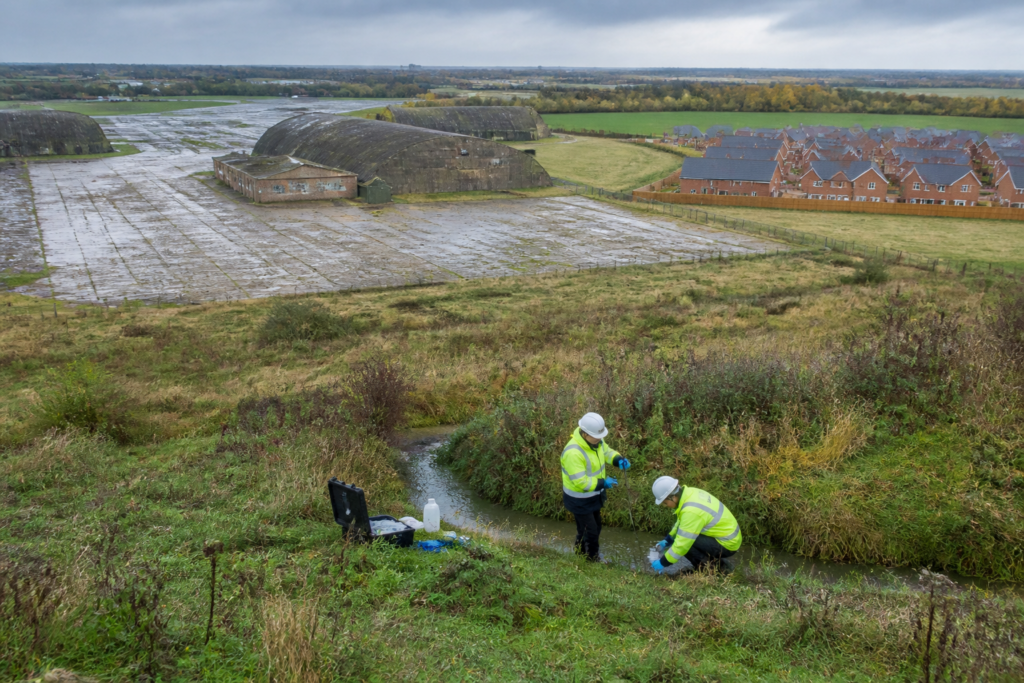
New investigation findings submitted in support of the proposed expansion of Heyford Park have put PFAS contamination at the former RAF Upper Heyford airbase firmly at the centre of the planning debate.
Reporting on 29 October said developer-commissioned work had identified what the report author described as exceptionally high PFAS contamination levels at the former military site, which is the subject of an outline proposal for around 9,000 homes. The investigations identified the historic fire-training area as the principal continuing source of contamination, while groundwater and surface-water results were reported to exceed relevant environmental screening standards.
The immediate change is not that development has been approved or that a final remediation solution has been agreed. Rather, the evidence base for the planning application has expanded materially, making the extent, movement and management of PFAS a central issue for Cherwell District Council, the Environment Agency, the developer and local communities.
A former fire-training area is the key focus
PFAS are a large family of persistent synthetic substances that have been used in numerous products and processes. Historic aqueous film-forming firefighting foams are a recognised source at airfields, military facilities and fire-training locations. The Drinking Water Inspectorate specifically identifies military bases, air transport sites, fire stations and training sites among the potential sources that should inform risk assessments for private water supplies.
At Upper Heyford, the reported focus on the fire-training area is therefore significant. A credible conceptual site model will need to establish not only the source-zone concentrations, but also the routes by which individual compounds may be moving through made ground, drainage infrastructure, shallow and deeper groundwater, ditches and downstream watercourses.
This matters because source removal, containment or treatment may be necessary alongside measures intended to make individual housing parcels suitable for their proposed use. A clean soil cover or localised excavation can be important for reducing direct contact risk, but it does not by itself resolve a wider groundwater or surface-water pathway.
What the findings mean for the planning process
Dorchester Living has said that it expects further investigation and any necessary remediation to be secured through the planning process. That is a proposal rather than a concluded regulatory outcome. Cherwell District Council remains responsible for determining the planning application and can require appropriate investigation, remediation and independent verification where needed before development or occupation.
The council’s current public information states that it will assess new applications individually and take a precautionary, evidence-led approach, particularly for sensitive uses such as housing. It also says that responsibility for securing a safe development rests with the developer or landowner where contaminated land is affected.
For a scheme of this scale, the practical challenge is likely to be sequencing. The site will need sufficiently robust information to support the strategic planning decision, followed by parcel-specific intrusive work, remediation designs, verification plans and completion evidence. Controls may also be needed for earthworks, stockpiling, dewatering, imported materials, drainage installation and the handling or disposal of contaminated soils and waters.
The proposed primary school and existing homes near the former base increase the sensitivity of the issue. However, the presence of PFAS in environmental samples does not, on its own, demonstrate an immediate health risk to residents. Cherwell’s latest public update says there is currently no evidence of an immediate risk to health, and that the mains drinking-water supply serving the area complies with Drinking Water Inspectorate PFAS guidance.
Monitoring programme now needs to answer operational questions
Cherwell’s Environmental Monitoring and Water Working Group first met on 16 September 2026. It identified further groundwater and surface-water monitoring, improved understanding of drainage connections and a site-wide conceptual model as actions for the developer. The Environment Agency is continuing its own monitoring programme, subject to approvals, while the council is continuing sampling of local private water supplies and the public tap at Upper Heyford.
The next steps should concentrate on data that can support clear decisions rather than simply adding more isolated results. In practice, that means:
- sampling during wet and dry conditions to understand seasonal changes and runoff-driven mobilisation;
- distinguishing source-area impacts from downstream concentrations and possible background or third-party inputs;
- testing the integrity and connectivity of historic drains, ditches and culverts;
- assessing likely exposure pathways for residents, construction workers, school users, gardeners, controlled waters and ecology;
- setting out realistic remediation objectives for each development phase; and
- publishing an auditable verification approach before homes, community facilities or schools are brought into use.
Implications for organisations involved in the scheme
For developers and landowners, the key issue is programme certainty. PFAS investigations can require repeated sampling rounds, specialist laboratory capacity and interpretation that takes account of individual compounds rather than relying solely on a total PFAS figure. Early agreement on the conceptual model, sampling plans, reporting format and decision criteria can reduce the risk that late evidence disrupts reserved-matters applications, discharge of conditions or construction phasing.
For planning authorities and consultees, the priority is to ensure that conditions are enforceable, proportionate and linked to defined stages of development. Where remediation is required, independent verification should demonstrate that the agreed works have been completed and that the land is suitable for its intended use. This is distinct from imposing a blanket duty to eliminate every trace of PFAS from a large historic site.
For neighbouring businesses, landowners and water-supply operators, the emerging evidence underlines the value of retaining sampling records, drainage drawings, abstraction information and soil-movement documentation. These records may be needed to distinguish historic source areas, assess potential pathways and coordinate any future investigation.
The Upper Heyford findings are therefore likely to become a test of how a major brownfield regeneration proposal manages an emerging contaminant issue in public view. The most important milestones now are the publication of validated monitoring results, agreement on the site-wide conceptual model, and clear planning-stage requirements for phased remediation and verification.
Sources
- CitrixNews: RAF base chemical contamination worst in UK, report says
- Cherwell District Council: PFAS and land contamination at Heyford Park – latest news
- Cherwell District Council: PFAS and land contamination at Heyford Park – information for residents
- Drinking Water Inspectorate: Poly and perfluorinated alkyl substances