


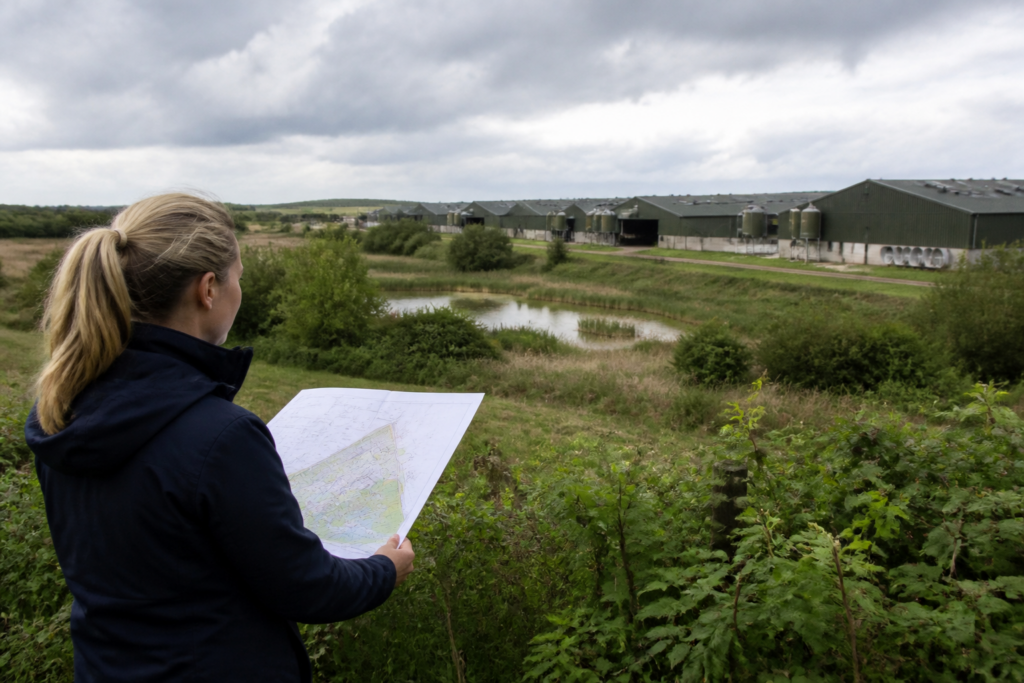
The Environment Agency has updated its intensive-farming permitting guidance in England, making SCAIL Agriculture the default tool for ammonia screening assessments. The change, recorded on 1 November 2026, affects applications for new bespoke environmental permits and variations to existing intensive pig and poultry permits where the proposal could alter ammonia emissions.
This is a change to Environment Agency guidance and permit-application process rather than a new standalone piece of legislation. However, it is likely to be significant for farms considering expansion, changes in livestock numbers or housing, revised ventilation arrangements, or alterations to slurry and manure storage.
What has changed
The previous ammonia screening tool has been replaced by SCAIL Agriculture, meaning Simple Calculation of Atmospheric Impact Limits. SCAIL Agriculture is an established online screening model used to estimate the likely effects of agricultural emissions on sensitive habitats and other receptors. It can estimate ammonia concentrations as well as nitrogen and acid deposition from agricultural sources.
The more material practical change is that the initial search area for designated sites is now linked to the total ammonia emitted by the farm. The updated approach replaces a simpler distance-based starting point with bands that increase as emissions rise. Consequently, the relevant ecological constraints search can extend much further for larger or higher-emitting installations.
Updated distances for protected sites
For Special Areas of Conservation, Special Protection Areas and Ramsar sites, the screening distance is now:
- 3 km where total farm ammonia emissions are up to 3,154 kg per year;
- 5 km for emissions above 3,154 kg and up to 7,884 kg per year;
- 10 km for emissions above 7,884 kg and up to 23,652 kg per year; and
- potentially up to 15 km where emissions exceed 23,652 kg per year, with applicants advised to contact the Environment Agency.
For Sites of Special Scientific Interest, the applicable distances range from 0.9 km to 5 km across the published emission bands. Farms emitting more than 94,608 kg of ammonia a year may need to screen beyond 5 km, again following discussion with the Environment Agency.
There are also revised distances for local nature sites, including National Nature Reserves, Local Nature Reserves, Local Wildlife Sites and ancient woodland. These extend from 0.4 km for the lowest emissions band to 2 km for farms emitting up to 94,608 kg per year, with potentially wider screening for higher-emitting sites.
Who should act now
Applicants must obtain a completed ammonia screening assessment before submitting a new intensive-farming permit application, or a variation application that may affect ammonia emissions. This includes proposals involving additional animals, different livestock types, enlarged slurry or manure storage, and changes to buildings or ventilation that could raise emissions or alter their dispersion.
The updated request process requires detailed site and operational information. Depending on the proposal, applicants may need to provide livestock numbers by housing type, ventilation details, building and vent heights, fan specifications, manure-storage data, site plans and grid references for livestock housing and stores. Proposals should also address compliance with the relevant best available techniques conclusions for intensive rearing of poultry or pigs.
Farms with existing permits are not automatically subject to a fresh assessment solely because the guidance has changed. The immediate relevance is principally to new applications and qualifying variations. Nonetheless, operators with expansion plans or permit changes in development should review their assumptions promptly, particularly where protected habitats lie beyond the distances previously considered.
When detailed modelling may follow
SCAIL Agriculture is a screening stage, not necessarily the final assessment. The Environment Agency will advise whether detailed air-dispersion modelling is required after it completes the screening assessment.
Detailed modelling is required where a proposal is within 250 metres of a protected conservation site, where screening indicates a potential effect on a protected site, or where stated screening thresholds are exceeded. The key thresholds include 1% for SACs, SPAs and Ramsar sites, 50% for SSSIs, and 100% for local nature sites. For SSSIs, results between 20% and 50% can trigger an assessment of combined emissions from other permitted farms in the area; detailed modelling may then be needed if the combined position exceeds 50%.
This means that cumulative effects remain important. A farm may not be assessed solely on its own predicted contribution where an SSSI falls within the applicable emissions-based screening distance.
Practical implications for projects and programmes
Project teams should allow more time at the early design stage for ecological mapping, emissions data collection and ammonia-screening requests. Higher-emitting proposals may need a wider search for designated sites, while detailed modelling can require specialist input and may influence the preferred building layout, ventilation design, manure-storage arrangements or proposed mitigation measures.
Applicants should also note the timing requirement: the permit application must be submitted within six months of the completed ammonia screening assessment, so screening should be programmed carefully alongside design, land and permitting work. Where bespoke emission factors or mitigation-adjusted factors are proposed, these need prior Environment Agency agreement; standard factors remain the normal basis for screening unless otherwise agreed.
The update does not guarantee that a proposal within a screening distance will require major redesign or be refused. It does, however, create a clearer and potentially broader evidence requirement for schemes with substantial ammonia emissions or sensitive ecological receptors nearby. Early engagement with the Environment Agency and appropriately scoped technical work will be important in avoiding late changes to a permit application.