


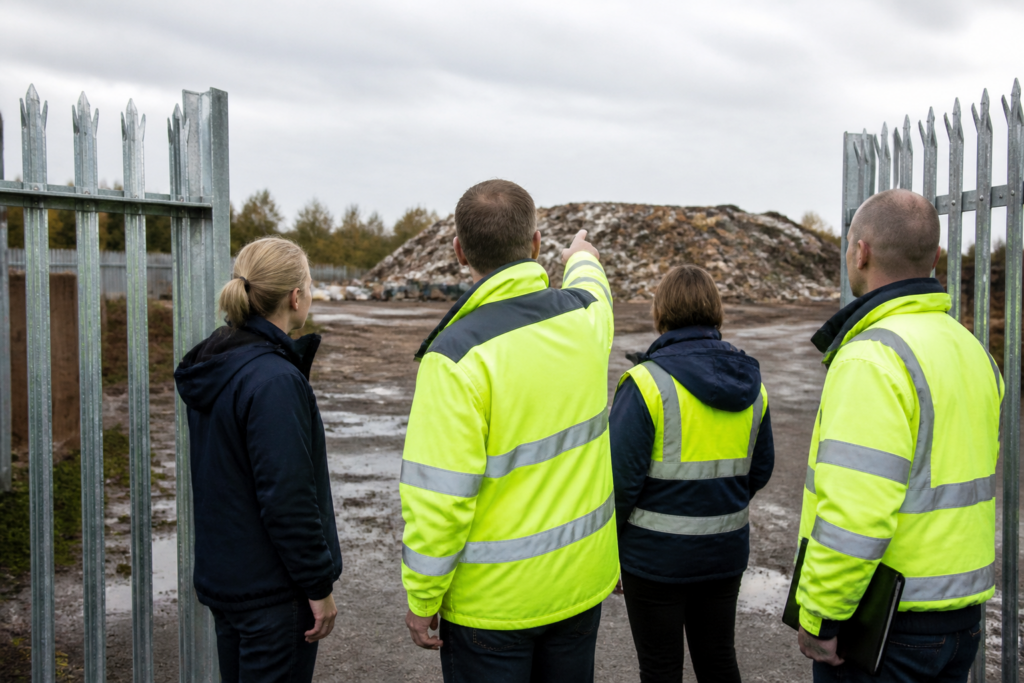
The response to the illegal waste site in Knowsley has moved beyond immediate site closure into a wider regional enforcement effort aimed at preventing organised waste crime from taking root elsewhere.
On 19 October 2026, the Environment Agency confirmed that it had closed the Knowsley site and blocked access in December 2025. The Agency says it remains involved in managing the location while an investigation continues with Knowsley Council, Merseyside Police, Merseyside Fire & Rescue Service and the UK Health Security Agency.
The update followed the first Liverpool City Region Waste Crime Conference, held in Widnes on 16 October. It brought together the Environment Agency, police, the Joint Unit for Waste Crime, Defra, local authorities, fire services and public-health representatives. The immediate outcome is not a new legal duty for individual businesses, nor a confirmed clean-up programme for the Knowsley site. It is a commitment by agencies to improve intelligence-sharing and coordinate interventions against illegal waste activity.
What has changed in practice
The important development is the formalisation of a regional multi-agency model around a live, high-profile illegal waste investigation. For enforcement bodies, this should make it easier to connect information on waste movements, suspect operators, vehicles, land access, fires, nuisance and potential health impacts.
It also places the Knowsley case within the government’s wider Waste Crime Action Plan for England. That plan combines prevention, enforcement and remediation measures. It includes an additional £45 million for Environment Agency waste-crime enforcement over three financial years, on top of a previously announced £5.6 million increase for 2026/27.
Since the Liverpool conference, Defra has established a national Waste Crime Crackdown Group, chaired by Environment Secretary Dame Angela Eagle. Announced on 4 November 2026, the group brings together ministers, regulators, police, Mayors and local authorities to identify weaknesses exploited by organised waste operators and remove barriers to enforcement. This national work reinforces, rather than replaces, the local partnership now operating across the Liverpool City Region.
Knowsley remains under investigation
The Environment Agency’s October statement is careful about the position at the Knowsley site. It confirms that access was shut down, but does not announce a clearance date, remediation specification, funding commitment or conclusion to the investigation.
This distinction matters. Under the national Action Plan, landowners are normally responsible for securing land and clearing illegally deposited waste, even where they were not involved in the offence. The Environment Agency may directly clear a site only in exceptional circumstances where waste presents an untenable risk to people or the environment. Government-led clearance also depends on further site-specific assessment of operational feasibility, environmental risk and community impact.
Organisations with an interest in the Knowsley site should therefore avoid assuming that central government intervention or a taxpayer-funded clean-up has been approved. Investigation, risk management, enforcement action and eventual remediation are related but separate processes, each capable of progressing at a different pace.
Implications for legitimate waste businesses
The regional focus will matter most to waste carriers, brokers, transfer stations, construction contractors, demolition firms, landowners and developers handling excavated materials. A more intelligence-led approach means regulators can increasingly compare permits, registrations, haulage activity, site intelligence and waste-movement records when assessing whether a waste chain is credible.
Digital waste tracking is particularly relevant. The national system became mandatory for licensed or permitted waste receiving sites in October 2026. Other parts of the sector will be brought into the service later. Businesses should check precisely whether their activities are already in scope rather than assuming the new requirement applies to every waste producer or carrier in the same way.
For projects in Merseyside and Halton, practical due diligence should include checking that carriers and receiving facilities hold appropriate authorisations, retaining clear transfer documentation, confirming the destination and recovery or disposal route for each waste stream, and questioning unusually low collection or tipping prices. Those checks do not create a guarantee against criminal conduct, but they are sensible evidence that a business has taken reasonable care over the lawful management of its waste.
Considerations for landowners and project teams
Landowners with vacant, remote or intermittently occupied land should review physical access controls, boundary security, monitoring arrangements and escalation contacts. The value of early reporting is likely to increase as local agencies pool information: vehicle registrations, photographs, dates, waste descriptions and evidence of repeated access can help establish patterns quickly.
For developers and consultants, waste controls should be considered early in construction environmental management plans and enabling-work packages. This is especially important where sites have multiple subcontractors, temporary haul routes, stockpiles or imported materials. Clear contractual allocation of waste responsibilities, auditable waste records and rapid reporting routes can reduce the opportunity for material to be diverted from legitimate facilities.
The Knowsley case does not itself introduce new compliance rules. Its significance is that a regional enforcement partnership is now being built around a real incident, at the same time as national policy is expanding surveillance, intelligence and enforcement capacity. Businesses that can demonstrate transparent, traceable waste arrangements will be better placed as scrutiny of waste supply chains intensifies.