


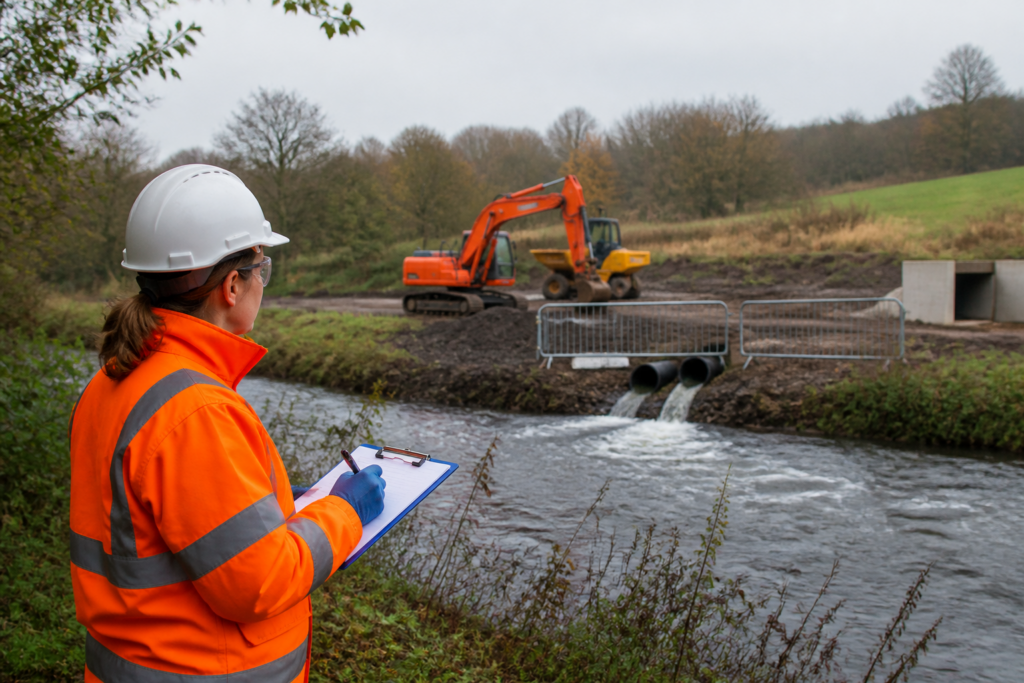
The Environment Agency has opened a consultation on seven proposed environmental-permitting exemptions intended to cover specified lower-risk construction activities in England. The consultation, which opened on 4 November 2026, closes on 29 December 2026.
This is an important distinction for developers, contractors and environmental managers: the exemptions are proposals, not new rules currently available for use. The Agency is testing both the activities that could be exempt and the conditions, limits and safeguards that would apply before deciding whether to introduce any or all of them.
The proposals sit alongside planned changes to the Environmental Permitting (England and Wales) Regulations 2016. Those changes are designed to give the Environment Agency a more direct role in creating, updating and withdrawing exemptions in England for certain activities, rather than requiring every change to follow the existing legislative route.
What activities are covered?
The seven draft exemptions are targeted at construction-related activities which the Environment Agency considers capable of being managed as lower risk when tightly defined and subject to appropriate conditions. They cover:
- temporary discharge of surface water from construction sites;
- ex-situ treatment of groundwater, with a proposed 1,000 cubic metre threshold;
- treatment of soils associated with groundwater, with a proposed 100 cubic metre threshold;
- temporary floating structures;
- temporary working platforms;
- taking core samples from in-channel structures; and
- temporary haul roads and access tracks.
The first three proposals are particularly relevant to projects involving dewatering, excavation, remediation or management of construction water. The remaining four concern activities that may otherwise interact with flood-risk permitting controls, including works in or close to main rivers and flood defences.
Although environmental-permitting exemptions can relate to waste operations, water discharges, groundwater activities and flood-risk activities, this consultation’s seven named proposals are focused on construction. Organisations should therefore avoid assuming that it creates a broad new waste exemption. Any future exemption will depend on its final wording, including the activity definition, volume limits, location restrictions, registration requirements and operating conditions.
Why the consultation matters
Environmental permitting exemptions are intended for activities where risks to people and the environment can be kept acceptably low without a full environmental permit. Some exemptions require registration; others do not. In either case, an exemption is not an unrestricted permission. An operator must remain within every relevant condition and limitation.
The Agency is consulting on whether it has identified risks correctly, whether the proposed safeguards are sufficient, and how the exemptions should operate in practice. The supporting documents include draft exemptions and accompanying risk assessments for each activity. This gives affected organisations an opportunity to comment on practical issues that can be missed in high-level policy design, such as construction sequencing, monitoring, discharge quality, temporary works design, ecological constraints, record keeping and the interaction with other approvals.
The policy direction is towards a permitting system that can respond more quickly to changing risk profiles while retaining proportionate regulatory oversight. However, faster amendment of exemptions should not be read as a relaxation of environmental protection. The proposed framework requires risk assessment and consultation before exemption conditions are set or materially revised, with the Environment Agency expected to publish relevant assessments, consultation outcomes and final conditions.
Flood-risk proposals may arrive by a different route
The consultation includes four flood-risk activity proposals, but the legal route for these is not yet aligned with that for waste, water-discharge and groundwater exemptions. The Government has laid secondary legislation for the latter categories, while indicating that further primary legislation would be needed to establish similar arrangements for flood-risk activities.
The Environment Agency says that, if the flood-risk proposals are supported, it intends to provide the benefits as soon as possible through time-limited regulatory position statements until formal exemptions can be implemented. A regulatory position statement is not the same as an exemption in legislation. It sets out an enforcement approach in defined circumstances and should be checked carefully against its precise scope, duration and conditions.
Practical implications for project teams
For now, project teams should continue to assess permitting needs under the current regime. An activity should not be treated as exempt merely because it resembles one of the seven consultation proposals. Existing environmental permits, exemptions, flood-risk activity permits, discharge consents, planning conditions, protected-species controls and landowner approvals may still be relevant.
Developers and contractors that regularly undertake dewatering, temporary drainage, in-channel investigation, access works or short-duration river-related construction should review the draft documents in detail. In particular, they should consider whether the proposed thresholds and conditions reflect normal site practice, whether they could unintentionally exclude common construction methods, and what evidence would be realistic to retain to demonstrate compliance.
Environmental consultants should also consider the interface between the proposed exemptions and contaminated-land risk management. Groundwater treatment and surface-water discharge can require clear conceptual site models, chemical testing, treatment design, discharge controls and contingency arrangements. An exemption, if eventually adopted, would not remove the need to prevent pollution or demonstrate that a project falls within its boundaries.
What happens next?
Responses must be submitted by 29 December 2026. The Environment Agency will consider consultation feedback before deciding whether to proceed with any of the proposals and, if so, on what final conditions. It has said that its response, any new exemptions, associated risk assessments and any relevant regulatory position statements will be published on GOV.UK.
For organisations with active or planned construction programmes in England, this is a consultation worth reviewing now rather than after project methods, procurement packages and environmental controls have been fixed. The outcome could create more proportionate routes for genuinely lower-risk temporary activities, but only where final eligibility criteria and conditions are met.
Sources and further reading
- Environment Agency – Exemption proposals for the environmental permitting regulations
- Environment Agency Consultations – CON_24089 Exemption proposals for the Environmental Permitting Regulations
- legislation.gov.uk – The Environmental Permitting (England and Wales) (Amendment) (England) Regulations 2026