


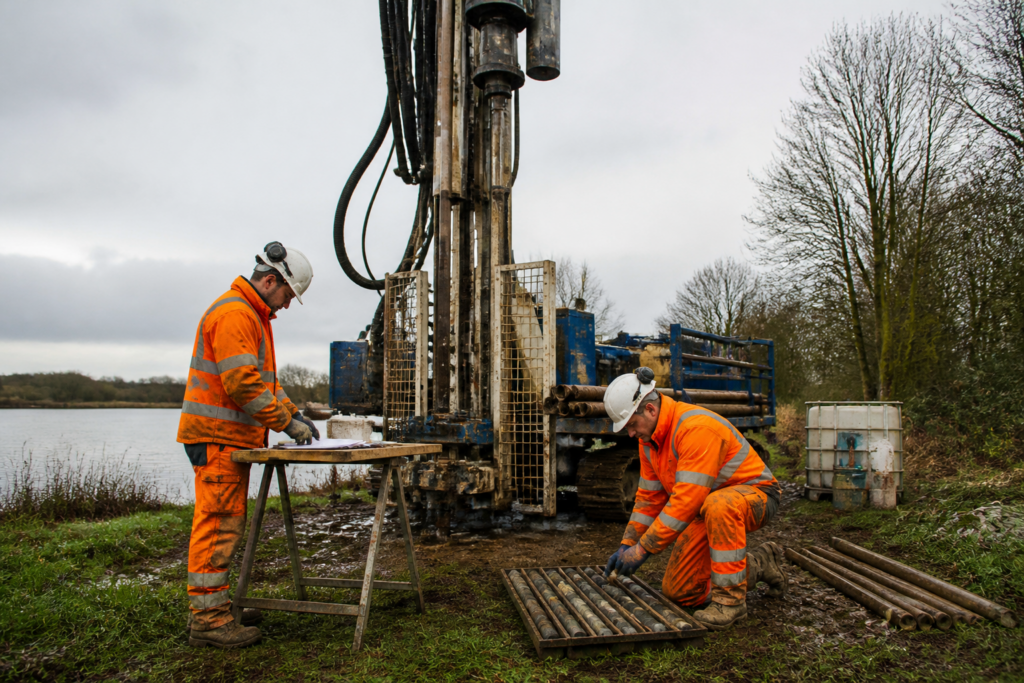
Anglian Water’s planned framework for ground-investigation works and services has reached a significant procurement milestone, with the published tender timetable showing a bid deadline of 27 October 2026. The framework has an estimated value of £29.54m excluding VAT and is intended to provide a route to market for a wide range of intrusive investigation, testing and specialist ground-risk services over an initial five-year period.
The procurement is not an award announcement and does not guarantee that the full estimated value will be spent. However, it is a clear signal that Anglian Water is seeking to establish a long-term supplier base for the ground, groundwater and environmental information needed to progress a large portfolio of water-resource and network projects.
Five lots separate major and lower-value assignments
The framework is divided into five lots, distinguishing works from professional services and separating contracts above and below £100,000. The largest element is ground-investigation works for higher-value commissions, followed by ground-investigation services for projects above that threshold. Further lots cover lower-value works and services, while a fifth lot is dedicated to groundwater-investigation works and services, typically for call-offs below £100,000.
That structure matters for the market. It creates potential routes for drilling and enabling-work contractors, geotechnical and geoenvironmental consultancies, laboratories, monitoring specialists and survey teams, rather than treating site investigation as a single bundled discipline. It should also provide a more accessible route for capable smaller suppliers on lower-value packages, although inclusion on the framework will not itself secure work.
The published scope is broad. It includes boreholes, trial pits and probe holes; in-situ and field testing; geophysical surveys; instrumentation; groundwater monitoring and pumping tests; sampling; laboratory testing; surveying; reinstatement; reporting; investigation design; desk studies; ground modelling and work supervision. Specialist requirements may extend to contaminated land, peat, floodplain deposits, mineral workings and embankment-dam investigations.
Major water-resource schemes sit behind the demand
The framework is tied to Anglian Water’s wider investment programme across the East of England, where long-term water resilience is being pursued through interconnecting pipelines, proposed reservoirs, desalination options and advanced water recycling. The company has said its Strategic Pipeline will ultimately form a 580km network, transferring water more flexibly across the region and reducing pressure on sensitive sources.
For ground-risk practitioners, that infrastructure context is important. Reservoir, pipeline, water-treatment and recycling projects require more than one-off factual drilling. They depend on iterative ground models that can support route selection, earthworks design, foundations, construction sequencing, dewatering assessments, ground-gas and contamination risk evaluation, materials management and environmental permitting decisions where applicable.
Groundwater investigation is particularly prominent. Monitoring installations, hydraulic testing and pumping tests can inform both engineering design and water-environment assessments, while robust baseline data is likely to be needed where schemes interact with aquifers, watercourses, historic industrial land or environmentally sensitive habitats. The framework therefore points to sustained demand for teams able to integrate geological, hydrogeological, geotechnical and geoenvironmental evidence rather than supplying isolated datasets.
What has changed for suppliers
The key change is that the procurement has advanced from market planning into the tender stage and has now passed the stated deadline. Suppliers that submitted bids will be assessed for appointment to the framework, with the procurement information indicating an estimated framework start in February 2027. The initial term is expected to be five years, with options that could extend the arrangement for up to a further three years.
For organisations that did not bid, the immediate opportunity to join this particular framework may be limited until a future procurement exercise. They should nevertheless track the eventual award notice and early call-off activity. Those results will indicate how Anglian Water has divided capability between contractors and consultants, the level of supplier coverage across the five lots, and whether specialist requirements are being delivered by framework members directly or through supply-chain arrangements.
Practical implications for appointed firms and their supply chains
- Resource planning: Appointed providers may need dependable access to rigs, operatives, laboratory capacity, monitoring equipment and suitably experienced supervisors at short notice.
- Integrated delivery: Bidders and prospective subcontractors should be ready to show how factual investigation, logging, sampling, testing, interpretation and reporting will be controlled as one quality-managed process.
- Groundwater competence: Teams should ensure that monitoring design, installation standards, sampling methods and test interpretation are aligned with the actual decision each commission must support.
- Site constraints: Major infrastructure routes and reservoir sites can involve access restrictions, agricultural land, ecology, traffic management, buried services, landowner liaison and reinstatement obligations. These constraints need to be reflected realistically in programme and cost assumptions.
- Supply-chain assurance: Specialist drilling, testing, surveying and laboratory partners should expect stronger scrutiny of competence, records, responsiveness and data quality where their output informs high-value design or regulatory decisions.
Anglian Water’s framework should therefore be read as a procurement-market signal rather than a statement that all named projects have received final approvals or will proceed on a fixed timetable. The practical value of the arrangement will emerge through individual call-offs. Even so, the combination of major water-resource development, pipeline delivery and routine groundwater needs suggests a substantial continuing requirement for well-planned, defensible ground investigation across the region.