


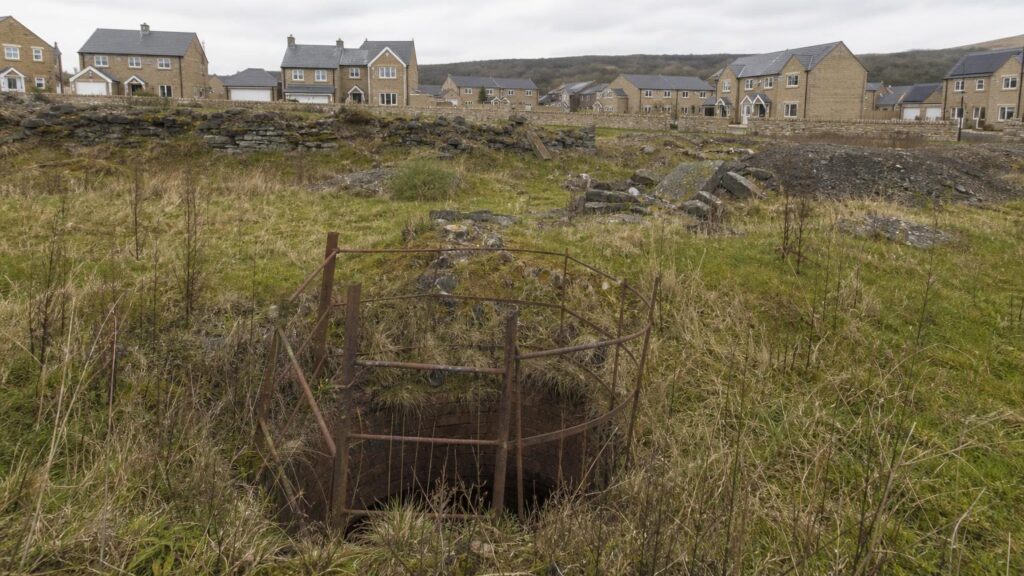
Mine shafts and adits can exist beneath or near your proposed building footprint without obvious signs at ground level. If you’re developing in a former coalfield, a Coal Mining Risk Assessment helps confirm whether legacy risks need managing.
Common Hazards Identified:
- Collapsible ground from historic shallow mining
- Open or poorly capped mine entries
- Gas migration from underground voids
- Ground movement affecting building stability
What a Coal Mining Risk Assessment Provides
We gather detailed data from the Coal Authority, historical maps, geological surveys, and other records. Our report includes:
- Summary of known coal mining features
- Assessment of associated risks
- Recommendations for further investigation (if needed)
This report forms an essential part of your due diligence and planning application.
How a mine shaft can affect a proposed building
The important question is not simply whether a historic mine entry appears on a plan. The project team needs to understand its location, condition, likely zone of influence and relationship to the proposed foundations and layout. In a Development High Risk Area, the Mining Remediation Authority expects a Coal Mining Risk Assessment for most forms of development and states that building over, or in close proximity to, mine entries should be avoided wherever possible.
Where a mine entry could constrain the development, its position may need to be confirmed by intrusive investigation before the layout is fixed. That evidence can then inform any no-build area, remedial work or foundation response rather than leaving the issue until construction.
What should a CMRA establish?
- Which recorded or credible coal-mining features could affect the site.
- Whether shallow workings, mine entries, ground movement or mine-gas pathways are relevant to the proposed development.
- Whether further intrusive investigation is justified and what it should target.
- Whether the development layout or foundation strategy needs to respond to a mining feature.
- What mitigation or remediation is needed to demonstrate that the site can be made safe and stable.
A Coal Mining Risk Assessment should therefore be a site-specific planning and design document, not simply a copy of a mining search. If you already have a mining report, planning condition or proposed site layout, include it with the enquiry so the assessment can be scoped around the actual development.
Do not assume there is one standard stand-off distance
A fixed generic distance is not a substitute for site-specific assessment. The appropriate response depends on the mine entry, ground conditions, proposed development and available investigation evidence. Where the entry materially affects the scheme, early assessment gives the design team the best chance of resolving it before the planning or construction programme is committed.
Official planning guidance is available from the Mining Remediation Authority. You can also read our guide to Coal Mining Risk Assessment costs.
Mine shaft in a garden or near a property: what does it mean?
A recorded mine shaft or adit in a garden, beneath part of a site or close to a property boundary does not automatically mean that a building is unsafe or that development cannot proceed. It does mean the feature should be understood before foundations, extensions, garages, driveways or other load-bearing works are designed.
Mine-entry records can be approximate, and historic treatment records may be limited. The key issues are the likely position and condition of the entry, the ground around it, and whether the proposed works could fall within its potential zone of influence.
What if a mine shaft is within 20 metres of the property?
A mining report may identify mine entries within 20 metres of a property boundary. This is a useful flag for further consideration, not a universal building exclusion distance. It should not be treated as proof that a shaft affects the house, nor as evidence that it does not.
For a proposed development, the relevant question is whether the mine entry could affect the specific layout, excavation, foundation loads or future occupiers. A Coal Mining Risk Assessment can review the available mining data alongside the development proposals and identify whether intrusive investigation, a revised layout or engineered remediation should be considered.
Before building near a mine entry
- Check the reported mine-entry location against the site boundary and proposed building footprint.
- Review any available mining report, planning condition, historic plans and treatment information.
- Avoid fixing the layout or foundation solution before the mine-entry risk has been assessed.
- Where records or ground conditions leave material uncertainty, target further investigation at the feature and proposed works.
- Obtain the necessary permissions before works that may enter, disturb or change coal mining property.
For homeowners, purchasers and developers, early assessment helps turn an unclear mining-search result into a proportionate next step. If you have a property plan, proposed extension drawing or mining report, include it with your enquiry so the assessment can focus on the actual relationship between the mine entry and the planned works.
For related guidance on budgets, see How Much Does a Coal Mining Risk Assessment Cost?.