


The Environment Agency last updated its guidance on disposing waste to landfill on 12 March 2025. The recorded amendment concerned separately collected recyclable and compostable materials, rather than a new WAC testing regime. However, the current guidance is a timely reminder for construction, remediation and waste-management organisations that landfill testing must be commissioned in the right sequence.
In particular, the guidance distinguishes between waste classification, basic characterisation and Waste Acceptance Criteria (WAC) leaching tests. These activities may be procured together, but they answer different questions. Treating a WAC result as a substitute for a waste classification assessment can lead to an unsuitable disposal decision, delays at the landfill gate or the need for further sampling and analysis.
Classification must come before landfill characterisation
For waste sent to landfill in England, the producer must first establish whether material is hazardous or non-hazardous and assign the appropriate List of Waste code. This is especially significant for mirror-entry wastes, where the classification depends on whether hazardous substances are present at relevant concentrations.
Only once that status is established should the producer complete basic characterisation for landfill acceptance. Basic characterisation builds a fuller picture of the waste stream: its origin, process history, treatment, physical form, composition, potential for recovery and the landfill class that may accept it. It can draw on analytical information generated for classification, but it is not a classification exercise in its own right.
The Environment Agency is explicit that basic characterisation cannot be used to classify waste. This is not simply a terminology issue. Classification determines the waste’s regulatory status, while basic characterisation helps demonstrate whether it is suitable for a particular landfill route and whether it meets the site’s acceptance procedures.
WAC testing is a landfill-acceptance tool, not the whole assessment
WAC testing is principally concerned with how contaminants may leach from a waste under specified conditions. It is commonly required where waste is proposed for inert landfill, hazardous landfill, stable non-reactive hazardous waste cells or landfill cells receiving gypsum-based material. The guidance identifies the up-flow percolation test, EN 14405, for basic characterisation leaching assessment in these cases.
That does not mean every waste needs the same laboratory suite. The likely contaminants, the intended landfill route, the material’s physical nature and its process history should all inform the scope. A laboratory may undertake classification and landfill-characterisation work within one instruction, but clients should ensure the quotation makes clear which analyses support each decision.
This distinction matters commercially as well as technically. A low-cost laboratory package that omits the determinands needed for a credible classification, or includes only a standard leaching test without the necessary waste-composition data, may not provide the evidence required by the receiving site. Conversely, unnecessary testing can add cost and prolong the programme.
Accreditation should be checked at method level
The Environment Agency says laboratories must be able to test submitted samples to an accredited standard and advises waste holders to speak to the laboratory before sampling. In practice, procurement teams should not stop at a general statement that a laboratory is UKAS accredited.
UKAS explains that ISO/IEC 17025 accreditation addresses matters including staff competence, test-method suitability, equipment, sample handling and quality assurance. Its accredited-organisation directory can be used to check a provider’s current status. More importantly, clients should review the laboratory’s scope to confirm that the specific preparation, analysis and leaching methods needed for the waste are covered.
- Ask which methods are accredited: confirm that the quoted determinands and relevant leaching procedure sit within the laboratory’s accredited scope.
- Confirm sample preparation capability: the guidance specifically says to establish whether the laboratory can prepare or crush material to the required particle size before samples are taken.
- Check sample mass and containers: compliance testing under the BS EN 12457 series requires a 2kg sample, while highly variable or coarse materials may need a different approach to obtain a representative sample.
- Establish turnaround assumptions: distinguish laboratory analytical time from the time needed for sampling, preparation, data review and preparation of classification or characterisation documentation.
Representative sampling remains the critical control
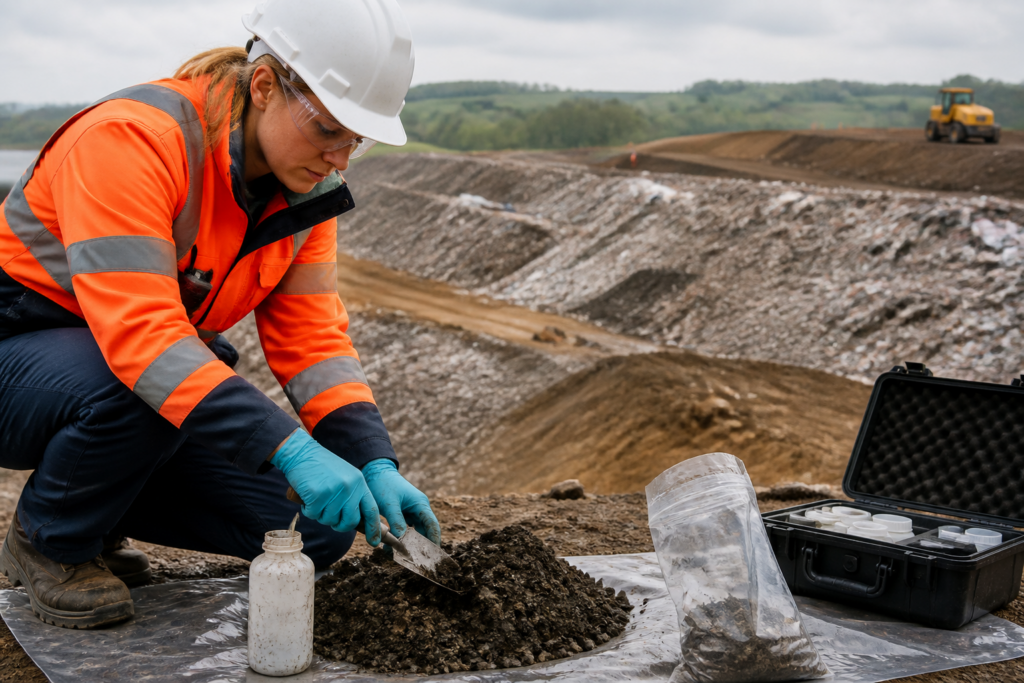
A technically capable laboratory cannot correct an unrepresentative sample. The guidance requires all submitted samples to represent the waste, with sampling plans developed using Appendix 4 of the Environment Agency’s WM3 technical guidance. The required number of samples depends on tonnage and whether the waste is homogeneous or heterogeneous.
For a single classified waste type of less than 100 tonnes, the published minimum table specifies two samples for homogeneous waste and five for heterogeneous or new waste. At 100 to 500 tonnes, this rises to three and eight samples respectively. Those figures demonstrate why a single grab sample from a variable stockpile may be inadequate even where the material is described under one waste code.
Visible organics, asbestos, gypsum and other components requiring separate handling must also be identified during sampling. Materials removed because they are unsuitable for laboratory analysis do not disappear from the regulatory assessment: the producer must document the approach and classify those separated components so that an appropriate recovery or disposal route can be selected.
Actions for waste producers and project teams
Organisations planning landfill disposal should review their testing procurement before material leaves site. Start with a clear description of the waste’s origin, likely variability, estimated quantity, treatment history and intended destination. Obtain the landfill operator’s acceptance requirements early, then instruct competent advisers and laboratories to develop a sampling and analytical strategy that separates classification evidence from landfill-acceptance evidence.
Where a waste stream is regular and consistently generated, basic characterisation can support periodic compliance testing. Where material is mixed, newly arising or inconsistent, each batch may need separate characterisation instead. Any process or input change should trigger a review of the existing data rather than an assumption that historic results remain valid.
The March 2025 update does not create a new deadline for WAC testing. It does, however, reinforce the established discipline behind a defensible landfill route: classify first, characterise the waste for the proposed destination, sample representatively and use a laboratory whose accredited capability matches the required methods.