


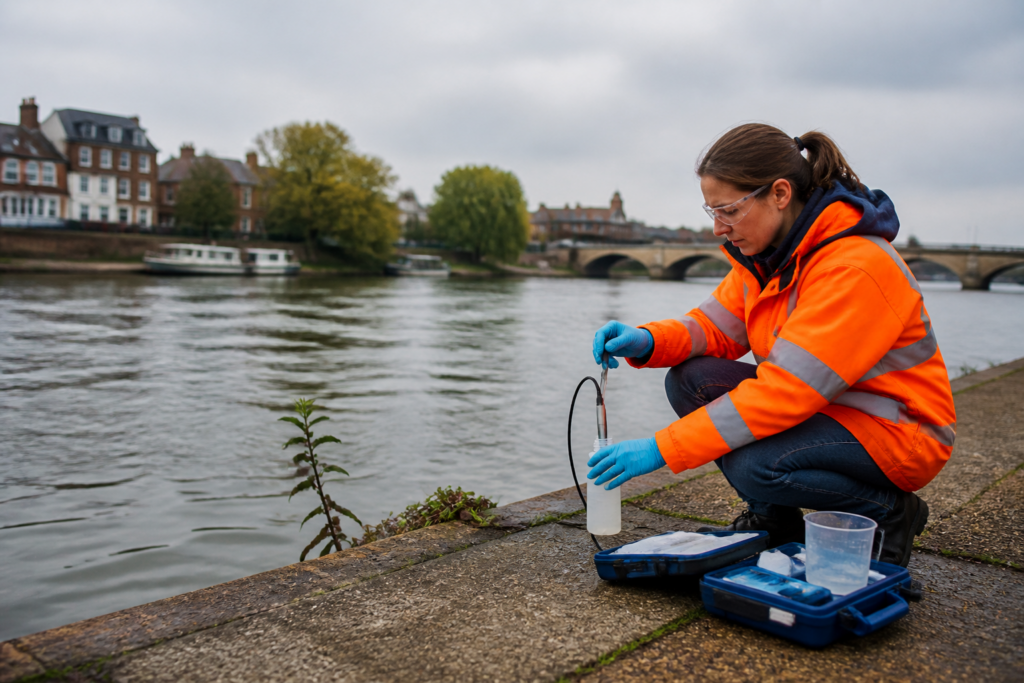
Reported pilot results from Thames Water’s proposed Teddington Direct River Abstraction (TDRA) scheme have intensified attention on how PFAS removal would be demonstrated before treated water could be returned to the River Thames.
The Guardian reported on 27 August 2026 that pilot trials for tertiary treatment at Mogden Sewage Treatment Works recorded PFOS concentrations of 6.3 nanograms per litre and 8.7 nanograms per litre. The figures were compared with the 0.65 nanograms per litre freshwater environmental quality standard used for PFOS. Thames Water has said that pilot data does not represent the quality of water that would be discharged by the final operational scheme.
The development matters because TDRA is intended to provide a strategic drought-resilience option for London. Under the current proposal, up to 75 million litres of water per day could be abstracted upstream of Teddington Weir and transferred towards reservoirs during drought conditions. An equivalent volume of advanced-treated wastewater from Mogden would be returned to the Thames to maintain river flows.
It is not an approved operational scheme. It remains subject to further project development, a Development Consent Order process and an environmental permit from the Environment Agency. The reported pilot outcome is therefore not, by itself, evidence that a future discharge would breach a permit. It is, however, material evidence on the practical treatment performance that the final design will need to achieve.
A distinction that matters: pilot concentrations and compliance
The 0.65 nanograms per litre figure is a freshwater environmental quality standard for PFOS. Environmental quality standards are used to assess and manage chemical risks in receiving waters; they are not automatically identical to a discharge consent limit at the end of a treatment works.
For a project of this scale, regulators are likely to consider the proposed discharge quality alongside river flow, dilution, background concentrations, cumulative pollutant loads, sampling arrangements and the chemical status objectives for the affected water body. The scheme would also need to address the specific behaviour of PFAS: their persistence, mobility and potential to accumulate in the environment.
That does not lessen the significance of the pilot data. On the contrary, it makes the next design stage more exacting. A process that performs inconsistently in a pilot, or only meets an outcome through frequent media replacement and regeneration, can affect plant sizing, operating costs, waste handling, energy demand, maintenance regimes and confidence in drought-time availability.
Why the findings are significant for TDRA
TDRA is designed for periods when water-resource pressure and environmental sensitivity may coincide. Thames Water says the abstraction element would be used during droughts, with the proposed tertiary plant kept in standby mode outside those periods. That operational model raises important questions beyond average treatment efficiency.
- Start-up and standby performance: treatment media and controls would need to deliver the intended removal performance after periods of low-throughput operation.
- Peak and variable influent quality: a robust design must account for changes in wastewater composition, including episodic industrial or domestic PFAS inputs.
- Whole-system reliability: monitoring, alarms, bypass prevention, maintenance and contingency arrangements need to be designed around the conditions in which the asset will actually operate.
- Residuals management: PFAS is transferred rather than destroyed by some treatment processes. Spent carbon, concentrates and other residual streams require a credible, permitted management route.
- River and groundwater assessment: the environmental case should consider direct aquatic effects, sediment and biota pathways, recreational use and any relevant groundwater receptors or hydraulic connections.
Implications for permitting and environmental assessment
Thames Water has stated that the scheme cannot operate without an Environment Agency permit. Any future application will need to make a clear case that the discharge will protect the receiving environment and comply with applicable permit conditions. The Environment Agency’s surface-water risk assessment approach expects applicants to compare predicted concentrations with relevant environmental quality standards and to undertake further modelling where screening indicates a potential concern.
For TDRA, the reported PFOS outcome is likely to increase the importance of transparent mass-balance modelling and representative monitoring. A persuasive assessment would distinguish between raw sewage, conventional final effluent, tertiary-treatment output and the concentration predicted within the river after mixing. It should also explain the basis for PFAS analyte selection, laboratory detection limits, sampling frequency, quality assurance and the treatment of non-detect results.
PFOS should not become the only parameter in view. Government work published in January 2026 notes that PFOS is currently the only PFAS with a statutory environmental quality standard, while science-based thresholds are being developed to help manage other PFAS in surface waters. This means project teams should avoid treating compliance with one PFOS benchmark as a complete PFAS risk assessment.
What organisations should consider next
For water companies and infrastructure promoters, the immediate priority is to translate pilot evidence into a final, auditable treatment and operating case. That includes defining performance targets under realistic influent conditions, testing breakthrough risk, demonstrating resilience during drought activation and identifying the cost and environmental consequences of carbon replacement or alternative treatment trains.
Environmental consultants supporting strategic water schemes should review whether EIA, Water Framework Directive assessment, environmental permitting work and construction design are using a consistent conceptual model. PFAS sources, pathways and receptors need to be aligned across these workstreams rather than handled as a narrow wastewater-treatment issue.
Local authorities, landowners, environmental groups and businesses with river-dependent operations should follow the consent timetable and request clarity on proposed monitoring, disclosure of operational data, emergency response arrangements and post-construction verification. Thames Water completed its main statutory consultation in 2025 and held a supplementary consultation on updated plans near Burnell Avenue from 21 May to 18 June 2026. The next formal opportunities to examine the evidence will depend on the project’s progression towards its consent and permitting applications.
The central issue is now less about whether London needs additional drought resilience, and more about whether the proposed treatment system can provide it with demonstrable and maintainable protection for the Thames. The pilot findings make that question harder to defer.
Sources and further reading
- Thames Water – Teddington Direct River Abstraction
- GOV.UK – Developing thresholds for managing PFAS in the water environment
- GOV.UK – Surface water pollution risk assessment for your environmental permit
- GOV.UK – Thames Water Teddington direct river abstraction: Section 35 Direction, Planning Act 2008