


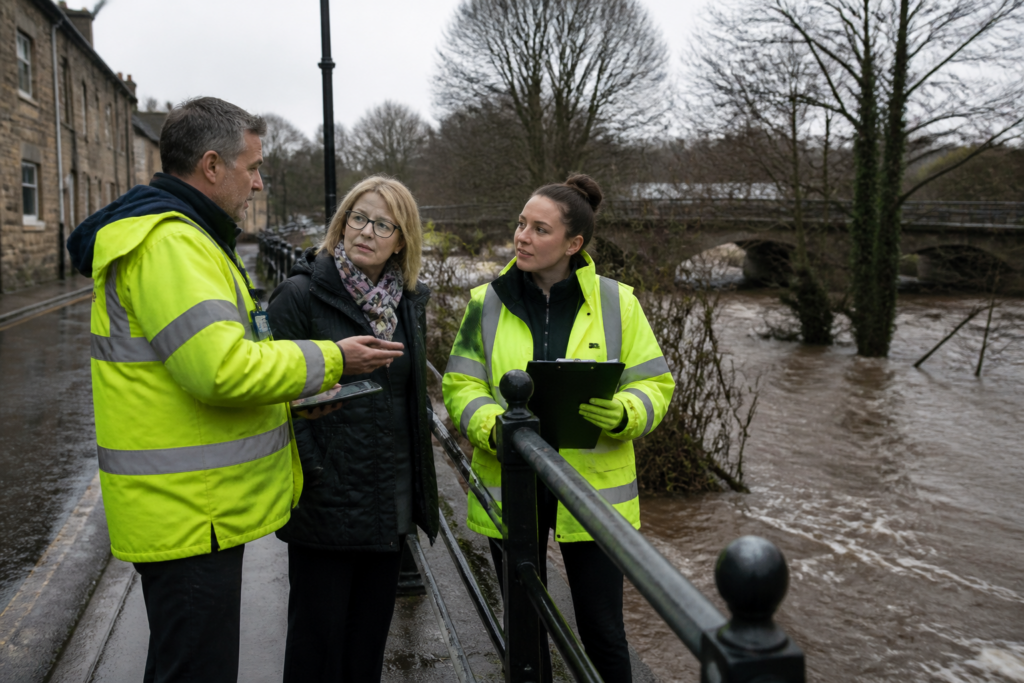
Greater Manchester Combined Authority (GMCA) has confirmed the award of its North West Community Flood Resilience Engagement Support Services contract to Newground CIC, marking a shift from a proposed procurement to an active regional support programme.
The contract is intended to provide an independent link between communities affected by, or vulnerable to, flooding and the public bodies and utilities responsible for flood and coastal risk management. It will operate across the North West of England, rather than being limited to Greater Manchester.
Although the notice was published on 16 September 2026, it is an award notice rather than a new tender opportunity. GMCA approved the award in July 2026, with the service scheduled to begin on 7 September 2026. Organisations looking to bid should therefore note that there is no live submission deadline attached to this notice.
What has been commissioned
The appointed provider will support engagement with residents, tenants, businesses, agricultural businesses and farmers in communities that have experienced flooding or face future flood risk. The work is also expected to include a smaller, but significant, coastal-change element, helping coastal authorities plan engagement and develop public-facing online information.
The service is designed to complement, rather than replace, the work of risk management authorities. Its purpose is to make flood-risk information more understandable, improve preparedness and encourage practical resilience measures at community level. This matters particularly after flood events, when residents and businesses may need clear information quickly but responsibility for different flood sources can sit with several separate organisations.
GMCA’s procurement notice identifies a need for the provider to work constructively with local authorities, the Environment Agency, United Utilities, elected representatives, the North West Regional Flood and Coastal Committee and the region’s flood and coastal risk management partnerships. The programme is primarily funded through the North West Regional Flood and Coastal Committee.
Contract value and timescale
The initial three-year contract has an awarded value of £1,099,914. The published notice gives an estimated service period from 7 September 2026 to 6 September 2029, with options that could extend the arrangement beyond the initial term, subject to funding.
GMCA’s delegated decision record states that Newground CIC was the highest-scoring bidder following an open competition. Assessment considered relevant community engagement and programme-delivery experience, cultural competence, proposed delivery, social value and price.
A key operational feature is the transfer of management and continued development of an existing public-access website. The Environment Agency retains intellectual-property rights over its content, while the provider is expected to keep the resource current and use it to extend the reach of direct local engagement.
Why the distinction between engagement and delivery matters
The commission does not create a new legal duty on householders, landowners, businesses or developers to undertake particular flood-defence works. Nor does it transfer statutory responsibility for managing flood risk to the engagement provider.
In England, flood-risk responsibilities remain distributed between risk management authorities. The Environment Agency has a strategic overview role and operational responsibilities for main rivers, reservoirs, estuaries and the sea. Lead local flood authorities lead on local flood risks such as surface water, groundwater and ordinary watercourses, while water and sewerage companies manage risks associated with their relevant networks. Coastal authorities also have distinct roles in managing erosion risk.
The practical value of the new service is therefore likely to lie in helping people understand those boundaries, identify the right route for concerns and participate more effectively in local resilience activity. That could include improving awareness of property-level measures, flood warnings, emergency planning, land-management discussions and the limitations of engineered defences in isolation.
Implications for councils, businesses and project teams
For local authorities and other risk management authorities, the programme offers additional capacity for engagement where local trust, accessibility and coordination are difficult to maintain. The procurement specifically recognises that some communities are harder to reach because of deprivation, differing demographics or rural and urban circumstances. Engagement approaches will therefore need to be adapted rather than treated as a standard communications exercise.
Businesses, including farms, should view the programme as a potential route to clearer information and more coordinated discussions about operational continuity, site access, drainage, warning arrangements and recovery planning. It is not a substitute for business-specific flood-risk assessment, insurance advice or maintenance of private drainage and resilience measures.
For developers, landowners and environmental consultants, the award reinforces the increasing importance of early and credible communication around flood risk and drainage proposals. Project teams should continue to address formal planning and technical requirements through the relevant planning authority, lead local flood authority and other consultees. However, schemes in sensitive catchments may benefit from a clearer explanation of residual risks, maintenance responsibilities and how proposed measures relate to wider community resilience.
What to consider next
- Risk management authorities: identify where the new regional service can supplement existing community engagement, particularly following flood incidents or in areas with repeated surface-water and sewer-flooding concerns.
- Businesses and farms: review flood emergency, continuity and communications arrangements, and engage through appropriate local channels where support activity is offered.
- Coastal authorities: consider whether local adaptation and shoreline-management communications need to be aligned with the programme’s coastal-change work.
- Development teams: retain focus on robust flood-risk, drainage and maintenance evidence; community engagement can support understanding but does not replace statutory consultation or planning requirements.
The award signals sustained public investment in the people-facing side of flood resilience. It recognises that reducing flood impacts depends not only on infrastructure, but also on accessible information, realistic expectations and coordinated relationships between communities and the organisations managing risk.